Category: Featured

  • Calls grow for Kemp to veto bill making some metro elections nonpartisan

    Calls grow for Kemp to veto bill making some metro elections nonpartisan

    Calls grow for Kemp to veto bill making some metro elections nonpartisan

    Republicans and Democrats are calling for Gov. Brian Kemp to veto House Bill 369, a bill that would make some elections nonpartisan in some metro Atlanta counties.

    If made law, Fulton, DeKalb, Gwinnett, Cobb and Clayton counties would see a shift to nonpartisan races for district attorneys, county commissioners, tax commissioners and other local offices. The changes would begin in 2028.

    Stephen Aaron, chairman of the 9th Congressional District Republican Party, told WABE he is advocating against the bill.

    “This is something that we’ve been fighting for the past 15+ years. It seems like every session, there is some new effort to make another local office nonpartisan,” Aaron said. “This takes away accountability from the voters. It takes away voters’ ability to identify basic philosophy of who’s running when someone’s running for a certain office and realistically it’s just bad policy.”

    Supporters say the bill will reduce partisanship while critics argue it would make elections more confusing for voters.

    Gerald Rose, founder of New Order National Human Rights Organization, told Atlanta News First that he wants Kemp to veto the bill.

    “The voters are being very confused on that. That’s why we want him to veto this bill,” he said.

    Mshawi Ikner, a DeKalb County voter, said it is unfair that the bill only targets a few counties.

    “To me it’s discrimination. One hundred and fifty-nine counties, you got five counties you just targeting,” Ikner said.

    District attorneys in the affected counties have said they are prepared to file a lawsuit if the law is enacted.

    Kemp has until May 12 to either veto or sign the bill, or he could let the bill become law by not acting.
  • Suwannee River named 10th most endangered over pollution, water use

    Suwannee River named 10th most endangered over pollution, water use

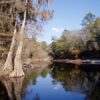
    A new report from American Rivers ranks the Suwannee River as the 10th most endangered river in the country, citing nitrate pollution and heavy groundwater withdrawals. The Suwannee remains one of the Southeast’s few largely undammed rivers, beginning in the Okefenokee Swamp and flowing south into Florida.

    Peter Raabe, the Southeast regional director for American Rivers, said problems originating upstream are affecting the entire watershed.

    “It is not being able to serve all the purposes that it should be,” he said. “And so, because of some of the pollution that is going in there and some of the water management issues, we’re starting to see impacts to the health of the river.”

    More than 300 freshwater springs feed into the Suwannee, but elevated nitrate levels — largely tied to fertilizers and livestock operations — are contributing to algae growth and raising concerns about drinking water quality.

    Raabe described the river as an uncommon natural resource, pointing to its long, uninterrupted flow. 

    “The Suwannee is really unique,” he said. “Whether it’s from its headwaters up in Georgia coming out of the Okefenokee Swamp and/or flowing all the way down to the Gulf, you’re talking about a river that is free-flowing, where it doesn’t have any dams, and that’s so rare. I think it’s 171 miles of free-flowing river, and that is something that not a lot of communities get to have that sort of a benefit.”

    Although the river is designated as an Outstanding Florida Water once it enters Florida, both water quality and flow levels are under strain. The report says Florida has not consistently enforced its cleanup requirements, while Georgia remains critical as the steward of the river’s headwaters. The state’s regional water planning framework emphasizes conservation efforts and reducing pollution from diffuse sources.

    Environmental advocates are calling on both states to step up protections by funding improved agricultural practices, upgrading wastewater systems, and expanding groundwater monitoring — steps they say are necessary to preserve the river’s future.

  • Georgia public colleges to raise tuition for 2026–2027 school year

    Georgia public colleges to raise tuition for 2026–2027 school year

    Georgia public colleges to raise tuition for 2026–2027 school year

    Georgia’s public colleges and universities are raising tuition for students this upcoming fall.

    The Board of Regents for the University System of Georgia voted Tuesday to increase tuition by 1% for in-state students and 3% for out-of-state and international students for the 2026-2027 academic year.

    “For more than a decade, USG and the Board of Regents have prioritized keeping college affordable for families so more students can pursue higher education right here in Georgia,” USG Chancellor Sonny Perdue said in a news release. “With enrollment at record levels, we’re focused on limiting new financial hurdles and delivering real value on every campus. Today’s decision reinforces that commitment.”

    The USG is made up of 25 institutions in the state. The Board also approved changes to mandatory fees at 13 of those institutions.

    This is the fourth time in 10 years that the Board approved tuition increases. For the 2024-2025 academic year, Georgia colleges averaged tuition costs at $5,924 for in-state students and $16,740 for out-of-state students, according to College Tuition Compare.

    “We are making a continued investment in Georgia’s future and in the students whose degrees will drive Georgia’s economy, strengthen our communities and open doors to prosperity,” Perdue said.

  • Kemp weighs bill to bring more international doctors to rural Georgia

    Kemp weighs bill to bring more international doctors to rural Georgia

    Kemp weighs bill to bring more international doctors to rural Georgia

    A bill is now on Gov. Brian Kemp’s desk that could increase the number of medical professionals in Georgia, specifically in rural counties.

    Senate Bill 427 passed with bipartisan support and would help bring doctors from outside the country to work in rural counties, hospitals and medical schools.

    Natalie Crawford is the executive director of Georgia First, a nonprofit that advocates for healthcare access. She told GPB News that the bill allows internationally trained physicians to acquire a limited provisional license to be able to practice medicine under supervision.

    “We feel like that’s an important step in attracting more talent, more medical professionals to Georgia, especially in rural areas where oftentimes we don’t have adequate access to care for patients,” she said.

    Crawford highlighted that around 500,000 Georgians are set to lose their healthcare coverage over the next 10 years due to the One Big Beautiful Bill Act, and her organization is advocating for expanding Medicaid in Georgia.

    “We think the best next step for Georgia is to expand Medicaid, and that would unlock a new option for hundreds of thousands of Georgians, getting us extra federal funding to help cover them,” Crawford said. “Expanding Medicaid in Georgia would help to keep more people in the workforce, boost our economy, and protect our rural hospitals.”

    Kemp has until May 12 to sign or veto the legislation before it automatically becomes a law.

  • Amanda Litman: The mantra still, is “Run For Something!”

    Amanda Litman: The mantra still, is “Run For Something!”

    Hosts Caroline and Debra are no strangers to “getting off the sidelines” and choosing to dive into politics. For Caroline it was swiping right on a dating app just to get an “in” with a presidential campaign she wound up interning and working for. For Debra, it was the ‘Dobbs’ decision from the US Supreme Court that spurred her into action, inevitably running for office.

    Their guest this week founded just the left-wing organization that aims to spark that sort of activism from everyday Americans to … well, “Run For Something.” Or to at least get involved.

    Hear Caroline and Debra catch up with Amanda Litman, author of “Run For Something” and co-founder of the organization by the same name and see if you, too, become inspired to involve yourself more.

  • South Georgia food banks strained as demand rises and supplies shrink

    South Georgia food banks strained as demand rises and supplies shrink

    South Georgia food banks strained as demand rises and supplies shrink

    Georgia counties below the gnat line face higher levels of food insecurity than the national average, and food banks that serve the area have seen an increase in demand and a decrease in supply streams.

    Frank Sheppard, president of Feeding the Valley food bank in West Georgia, told GPB News that most food pantries in his service area have had to reduce the amount of food they give out.

    “This food shortage is no surprise to anyone,” he said. “But this crisis has really surged in the first quarter of the calendar year, making it just that much more difficult.”

    He said they have seen less donations from retailers, manufacturers and farmers as well as a decrease in federal commodities.

    Eliza McCall,with Second Harvest of South Georgia, told GPB that they had a food pantry in Turner County that no longer could afford weekly meal distributions. The food pantry is seeking donations for $15,000 to keep their weekly distribution, but they have only raised $875 so far.

    “We are seeing people who have never needed help before in the last few years have needed that,” McCall said. “We are hearing them talk about food prices, we are hearing the talk about gas prices, it’s a lot of different factors.”

  • Georgia community solar expansion stalls despite bipartisan support

    Georgia community solar expansion stalls despite bipartisan support

    Georgia community solar expansion stalls despite bipartisan support

    Republican lawmakers sponsored bills in 2025 that would make it easier for communities to generate solar energy.

    Despite having the entire 2026 legislative session to pass it, the bills never made it to a vote in their chambers.

    The Georgia Homegrown Solar Act of 2025 was introduced in both chambers of the Georgia legislature by Republican lawmakers. Both bills received support from both Republicans and Democrats, but neither saw any traction.

    The law would have expanded community solar, which would allow residents, renters and businesses to subscribe to local solar projects to reduce the price of their electricity bill. If the bill had passed, consumers of electricity in Georgia would have been able to choose for a portion of their energy to come directly from solar power.

    “Basically a good way to think of it, it’s in the name. It’s basically like a localized solar array that multiple residential customers, homeowners, renters, whoever it may be can buy into. (22:51) So they’re sharing energy, and they’re also getting those on bill credits as well,” said Adrien Webber, the director of the Georgia Sierra Club.

    Georgia Power currently serves nearly 3 million customers in Georgia as of December 2024, and the company does offer a community solar program for residential customers. However, the program is not intended to save customers money and is only available to allow customers to support solar energy.

    The program costs $24 per 1 kilowatt block per month of solar usage for residential customers, which is almost $9 more than the average price per kilowatt in 2024.

    The Southern Alliance for Clean Energy published an article saying that Georgia Power’s current program is “unpopular, inefficient, and increases bills,” while most programs nationwide save 5-20% on average.

    “I mean, Georgia power, you know, they influence all of our statewide energy policy, obviously, but they don’t have the entire state. Like people have EMCs, people have co-op power,” Webber said.

    However, Webber said the areas where community solar could be really successful are in dense, urban areas, which is where Georgia Power mostly services.

    As of now, the expansion is on hold, but Webber said the Sierra Club will continue to advocate for this legislation.

    “This is where Sierra Club comes in. We meet with Republicans, we meet with Democrats, Independents, whoever it is, whoever these decision makers are, and we just try and really present the facts to them,” he said.

  • Helen’s off-season relies on locals to sustain small businesses

    Helen’s off-season relies on locals to sustain small businesses

    Helen’s off-season relies on locals to sustain small businesses

    The Bavarian-themed town of Helen, Georgia, sees nearly 2 million tourists during its peak season, which is between September and December, but during the off-season, Helen locals help keep the small businesses afloat.

    Chase Hogan works at Bodensee, a German restaurant that is usually packed out during Oktoberfest.

    “I know a lot of places in town close down, but the locals keep this place afloat in the really slow times,” Hogan said.

    Hogan said that he and other servers work around 200 double shifts straight through the busy season, but in the off-season, he gets a day or two off per week.

    The town of Helen keeps adding weeks to its Oktoberfest celebration to extend the busy season.

    Johann Ramsey, who lives in Helen, said after World War II, most of the population left Helen because the mine closed and the mill shut down.

    Local businessman and artist John Kollock redesigned the town into its current architecture in an attempt to save it from dying.

    “That’s what made Helen special. If we refused to die in the 1950s and 60s and we’re doing so again in the off-seasons, it’s that American spirit of saying, ‘We’re not going down, we’re going to keep going,’” Ramsey said.

  • A cheaper path to solar is here. Here’s why Georgia hasn’t joined in.

    A cheaper path to solar is here. Here’s why Georgia hasn’t joined in.

    A cheaper path to solar is here. Here’s why Georgia hasn’t joined in.

    A new way for individuals to harness solar energy is becoming popular in parts of the U.S. while Georgia lags behind adopting certain policies to encourage self-generated power.

    Plug-in solar, or balcony solar, could make solar energy more accessible for homeowners and renters to shrink their energy costs. Systems range from $500 to more than $4,000 making them significantly more affordable that traditional rooftop solar, which can cost around $30,000.

    The concept has been popular in Europe for years, and parts of the U.S, specifically California, have been quick to jump on board the trend. 

    Adrien Webber, the director of the Georgia Sierra Club, said people all over the world are starting to adopt balcony solar because of ongoing conflicts that create instability in fossil fuel markets, such as the wars in Iran and Ukraine.

    “We’re kind of already starting to see it in California and some other states because people are realizing that they can produce their own power. We call it energy freedom,” he said.

    But, utility companies are not very happy with this change, he said.

    “They make money off of charging you for power. So, if you start producing your own power with an unlimited resource like the sun, it’s something that they don’t like and their shareholders don’t like,” Webber said. “We are huge advocates of taking energy into your own hands, giving you that freedom to have a choice of how you power your home.”

    A typical 400-800 watt system costs between $500 and $1,500 and can generate enough electricity to shave roughly $15-$50 off an electric bill per month, according to Energy Sage.

    In the U.S., 23 states have active bills regarding plug-in solar with two states having fully passed legislation on the topic, according to Bright Saver’s legislation tracker.

    However, Georgia lawmakers did not pass any legislation this year to allow for plug-in solar. State Rep. Imani Barnes, D-Tucker, introduced House Bill 1304 that would exempt balcony solar from certain regulatory requirements that apply to rooftop solar. Although the bill had bipartisan support, it never received a vote in committee.

    During a hearing for the bill, critics expressed concerns about the safety of the devices and whether a blanket exemption for interconnection agreements with utility companies was prudent, according to the Atlanta Journal-Constitution.

    Webber said a lot of misinformation gets disseminated from utility companies and the fossil fuel industry to discourage the use of clean energy.

    “I think that people want to believe the easy talking points from the fossil fuel industry, where in fact, if you read between the lines of what they’re saying and you poke at things a little bit more, you’ll see that what they’re saying is actually not true,” he said.

    The issue of safety could be addressed soon. The concern is that the devices could send power back onto the grid and could endanger the lives of lineworkers. UL Solutions, a global safety science company, created a certification program for the devices late last year and is working with manufacturers to achieve certification.

    A company spokesperson told the AJC that they expect to issue their first certification in the next few months.

  • Drought, heat and wind raise fire danger across Georgia

    Drought, heat and wind raise fire danger across Georgia

    Drought, heat and wind raise fire danger across Georgia

    Dry weather persists in Georgia landing most of the state in high fire danger conditions.

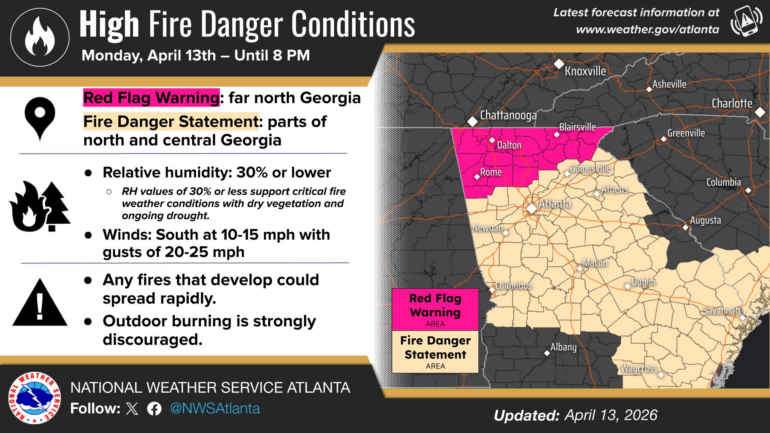
    The National Weather Service issued a Red Flag Warning Monday morning in portions of North Georgia due to low relative humidities and gusty winds. The warning lasted until 8 p.m. Monday.

    The dry weather will be accompanied with persistent warm temperatures this week. The high temperature will reach the low 90s in the Metro Atlanta area towards the end of the week. 

    The high temperatures are due to a persistent high pressure system over the Southeast causing very warm and dry weather. 

    Current drought conditions will worsen given the lack of rainfall this week, and rain chances will only slightly increase next weekend.

    Almost all of the state has been categorized as having more than moderate drought conditions with most of the state being categorized as in an extreme drought or exceptional drought. Exceptional drought is the highest category on the drought map by the National Weather Service.

    An exceptional drought means the agriculture economy is severely impacted, fire risk is high with an increase in fire activity, hydroelectric power generation is significantly reduced and tree mortality is high with army worm outbreaks likely to occur.

    These most severe drought conditions are mostly impacting the southern part of the state, which has also faced great damage from hurricanes in recent years.

    A map showing the Red Flag Warning in North Georgia.
    Credit: National Weather Service