-
 play_arrow
Georgia NOW Live Streaming Now
-
 play_arrow
The Politics Bar After Hours - Hide Your Couches!



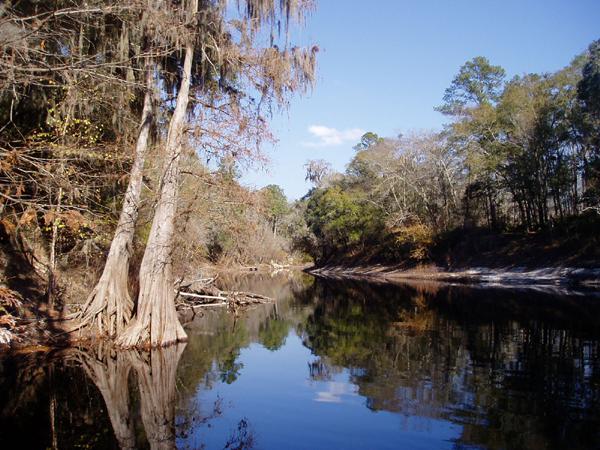
Credit: Florida State Parks
A new report from American Rivers ranks the Suwannee River as the 10th most endangered river in the country, citing nitrate pollution and heavy groundwater withdrawals. The Suwannee remains one of the Southeast’s few largely undammed rivers, beginning in the Okefenokee Swamp and flowing south into Florida.
Peter Raabe, the Southeast regional director for American Rivers, said problems originating upstream are affecting the entire watershed.
“It is not being able to serve all the purposes that it should be,” he said. “And so, because of some of the pollution that is going in there and some of the water management issues, we’re starting to see impacts to the health of the river.”
More than 300 freshwater springs feed into the Suwannee, but elevated nitrate levels — largely tied to fertilizers and livestock operations — are contributing to algae growth and raising concerns about drinking water quality.
Raabe described the river as an uncommon natural resource, pointing to its long, uninterrupted flow.
“The Suwannee is really unique,” he said. “Whether it’s from its headwaters up in Georgia coming out of the Okefenokee Swamp and/or flowing all the way down to the Gulf, you’re talking about a river that is free-flowing, where it doesn’t have any dams, and that’s so rare. I think it’s 171 miles of free-flowing river, and that is something that not a lot of communities get to have that sort of a benefit.”
Although the river is designated as an Outstanding Florida Water once it enters Florida, both water quality and flow levels are under strain. The report says Florida has not consistently enforced its cleanup requirements, while Georgia remains critical as the steward of the river’s headwaters. The state’s regional water planning framework emphasizes conservation efforts and reducing pollution from diffuse sources.
Environmental advocates are calling on both states to step up protections by funding improved agricultural practices, upgrading wastewater systems, and expanding groundwater monitoring — steps they say are necessary to preserve the river’s future.


-

The Stephanie Miller Show
Weekdays at 10am
National morning drive radio and television star Stephanie Miller hosts The Stephanie Miller Show, reaching over six million listeners weekly on satellite and terrestrial radio, simulcast on FreeSpeech TV. A ratings powerhouse who dominated at KABC, KFI, and stations in New York and Chicago, she's been ranked on Talkers Magazine's "Heavy Hundred" for over a decade and won their Woman of the Year Award. Her sold-out Sexy Liberal Comedy Tour became the fastest-selling comedy tour in history, earning three Pollstar nominations and producing America's #1 comedy album. Praised by Rachel Maddow as "the high priestess of excellent liberal talk" and by Carol Burnett as "the Carol Burnett of radio," this Liberal icon—ironically the daughter of Barry Goldwater's 1964 VP running mate—is known as "The Voice of The Resistance."
close  From CBS News
- Trump faces pressure as midterms inch closer September 20, 2026President Trump triggered a showdown over the First Amendment after several journalists had their White House access revoked this weekend. The ban followed a week of bad economic news for the president. Aaron Navarro reports.
- ICE agent shoots and wounds man in Austin, Texas September 20, 2026The lawyer for the man identified him as a 28-year-old Venezuelan national, Wilber Rafael Garces Perez. Officials said he was shot at least once in the torso and was in serious but stable condition.
- Trump to meet Mamdani tomorrow in New York City September 20, 2026New York City Mayor Zohran Mamdani and President Trump have met at least twice since Mamdani was elected last year.
- Cassidy: Trump needs to be "radically honest" on vaccines amid measles outbreak September 20, 2026GOP Sen. Bill Cassidy of Louisiana urged the president to be "radically honest" when he's speaking about vaccines, as the U.S. this year has recorded the most measles cases in more than three decades.
- 18 suspects in killing of Haiti's president being extradited to Florida for trial September 20, 2026Eighteen suspects who were arrested in the July 2021 killing of Haitian President Jovenel Moïse were awaiting extradition to the U.S. on Sunday.
- Full transcript of "Face the Nation with Margaret Brennan," Sept. 20, 2026 September 20, 2026On this "Face the Nation with Margaret Brennan" broadcast, Reps. Ro Khanna and Maria Elvira Salazar join Margaret Brennan.
- Bessent meets with Chinese counterpart ahead of Trump-Xi summit September 20, 2026Treasury Secretary Scott Bessent is meeting with Chinese Vice Premier He Lifeng, ahead of the planned summit between President Trump and Chinese President Xi Jinping this week.
- Salazar tells Trump on Hispanic voters: "Preserve that fortune" September 20, 2026GOP Rep. Maria Elvira Salazar of Florida warned in a campaign ad last week that President Trump's immigration enforcement policy has "gone too far."
- Trump says proposed arch will also be a "top grade Military Complex" September 20, 2026President Trump said that he has agreed to convert plans for a massive triumphal arch into a "top grade Military Complex," equipped with snipers and drone storage.
- Trump says proposed 250-foot arch will be used as military complex September 20, 2026President Trump posted on social media early Sunday that his proposed 250-foot arch near Arlington National Cemetery will be used as a military complex, saying there will "large numbers of drones, plus Snipers, on both the roof and plaza areas, and additionally have and hold large quantities of sniper ammunition in storage."
- Trump faces pressure as midterms inch closer September 20, 2026
Post comments (0)