Tag: Georgia

  • Georgia among states driving rise in uninsured young children

    Georgia among states driving rise in uninsured young children

    Georgia among states driving rise in uninsured young children

    Georgia is among three large Southern states that account for more than half the national increase of uninsured children.

    A Georgetown University report found that the uninsured rate for young children is at its highest point in nearly a decade.

    Brittney Newton, senior policy analyst for the group Voices for Georgia’s Children, said the “unwinding” of Medicaid is a large contributor to the increase.

    “Beginning in 2023, states had to review eligibility for every Medicaid enrollee and many families lost coverage during that process,” Newton said. “Not because they were no longer eligible, but because of administrative issues, things like missing paperwork, incomplete forms, or overall communication breakdowns.”

    The state has launched “Stay Informed, Stay Covered,” an outreach campaign to help families navigate the renewal process. Newton said the renewal notices families receive are often confusing or arrive too late, if they come at all.

    Elisabeth Wright Burak, senior fellow at the Georgetown University Center for Children and Families and lead author of the report, said the loss of coverage has a severe impact on infants and toddlers.

    “Young children have much more frequent checkups in their earliest months and years of life to check their developmental progress and make sure we can catch any concerns or delays before they get to school,” Burak said.

    The report found that young children of color faced the highest uninsured rates with Native American and Alaska Native children under 6 facing a 10.5% uninsured rate nationally.

    Newton advocated for more transparent age and county-level data to help with outreach and presumptive eligibility, which would allow places, such as Head Start programs, to temporarily enroll eligible children while official applications are processed.

  • Georgia primary runoff early voting begins June 8 across the state

    Georgia primary runoff early voting begins June 8 across the state

    Georgia primary runoff early voting begins June 8 across the state

    Early voting for the runoff elections from the May primaries officially kicks off on Monday, June 8 with some counties opening earlier on Saturday, June 6.

    Because the runoff election is so soon after the primary election, voters will only have one week of early voting. 

    Some counties, such as Fulton County, will start early voting on June 6 because they allow for Saturday voting.

    After early voting closes on Friday June 12, voters will need to cast their ballots on Tuesday, June 16.

    The runoff elections will determine who will represent each party in state and federal elections.

    On the Democratic ticket, candidates are vying for seats as the lieutenant governor, secretary of state, commissioner of insurance and commissioner of labor.

    The Republican ticket has some more high profile runoffs. U.S. Rep. Mike Collins is competing against Derek Dooley for the nomination for U.S. Senate. The winner will face U.S. Sen. Jon Ossoff in the general election in November. 

    Rick Jackson is running against Lt. Gov. Burt Jones for a chance to face off against former Atlanta Mayor Keisha Lance Bottoms in the gubernatorial race.

    To find precinct information and a sample ballot, go to mvp.sos.ga.gov and enter your information.

  • Georgia awarded $25 million for PFAS cleanup amid EPA rule rollbacks

    Georgia awarded $25 million for PFAS cleanup amid EPA rule rollbacks

    Georgia awarded $25 million for PFAS cleanup amid EPA rule rollbacks

    The Environmental Protection Agency announced in May that Georgia would receive more than $25 million in grants to address PFAS, also known as “forever chemicals.”

    The announcement came shortly after the agency weakened federal drinking water protections for the toxic compounds.

    Documentation shows that Georgia has had evidence of PFAS contamination for nearly two decades.

    Maria Doa, senior director of chemical policy at the Environmental Defense Fund, said even a small amount of PFAS can be dangerous.

    “They’re extremely bad,” Doa said. “They cause so many different harms to the body at extremely low levels. And the other thing is many of these PFAS build up in your body and stay there for a long time.”

    Since the 1970s, the carpet industry in northwest Georgia has relied on the chemicals for stain resistance. In 2008, University of Georgia testing found “staggeringly high” levels of PFAS in the Conasauga River, which supplies drinking water to the area.

    With the EPA planning to roll back drinking water limits on four PFAS, Doa said the administration is putting industry profits ahead of the health of the public.

    “This is part of a coordinated approach to roll back protections,” Doa said. “And a lot of the people at EPA are former industry chemical lobby people who are there, and are integral to rolling back these regulations.”

    Written comments can be submitted to the EPA about the rollback until July 20 at regulations.gov, and a virtual public hearing is scheduled for July 7.

  • Jones County educator named Georgia’s 2027 Teacher of the Year

    Jones County educator named Georgia’s 2027 Teacher of the Year

    Jones County educator named Georgia’s 2027 Teacher of the Year

    A Jones County middle school teacher has been named the 2027 Georgia Teacher of the Year.

    Charm Mapp, an eighth-grade math teacher at Clifton Ridge Middle School, received the recognition after being named the 2025 Jones County Teacher of the Year.

    State School Superintendent Richard Woods announced the selection at a banquet, according to a news release from Georgia College and State University.

    “Charm Mapp makes mathematics come alive for her students through her classroom number talks and hands-on instruction,” Woods said. “I can’t wait to see how she advocates for students, teachers and schools throughout her time as Georgia Teacher of the Year.”

    Mapp earned her bachelor’s, master’s and education specialist degrees from GCSU making her a three-time alumna and is currently attending the university to earn her Ed.D.

    Mapp has worked at Clifton Ridge Middle School for 23 years and is the lead gifted teacher. She has mentored 19 student teachers and works with her fellow gifted teachers to hold monthly professional learning sessions.

    “While it’s important to challenge my students, I also want to make sure they’re supported,” Mapp said.

    In her new position as Georgia Teacher of the Year, Mapp will work as an advocate for public education in the state.

  • Atlanta nonprofit helps youth build careers and confidence

    Atlanta nonprofit helps youth build careers and confidence

    Atlanta nonprofit helps youth build careers and confidence

    An Atlanta nonprofit is helping youth and young adults who have had direct contact with the juvenile justice system.

    Cafe Momentum Atlanta started in May of 2025 with a mission to provide young people with life skills, education and job opportunities. The nonprofit has had 46 participants complete the one-year program.

    The participants, also called interns, are trained in different positions in the cafe, and when they are not working, they are on the other side of the building receiving mental health services, playing pool or doing schoolwork.

    Sandy Welfare, executive director of Cafe Momentum Atlanta, said that the program is designed to help participants learn everything about the restaurant business while also connecting them to services and community.

    “I think the biggest thing for me is that we actually offer hope,” she said. “We offer a pathway for whatever they may feel they want to do in the future.”

    She said the skills they learn can help them secure their next job.

    “These young people are figuring it out, and we’re helping them to figure it out, and the great thing is we’re a resource to give them guidance, give them some direction, and more importantly, when they leave, we’re going to still be championing them,” Welfare said. “We’re gonna still be jumping up and down for them.”

    Cafe Momentum Atlanta is open Wednesday through Friday for lunch and dinner services.

  • Federal judge reprimanded over affair, political event attendance

    Federal judge reprimanded over affair, political event attendance

    Federal judge reprimanded over affair, political event attendance

    A judge in the 11th Judicial Circuit, which includes Alabama, Florida and Georgia, had an affair with a high-ranking police officer, including having sex in the judge’s chamber. The judge also lied about the actions when first questioned.

    The judge received a “private reprimand” for the actions, according to an investigation by the court system.

    The judge’s name and court location was not disclosed.

    The investigation found that the judge had sexual intercourse with an unidentified officer in the judge’s chambers during business hours and within earshot of staff. The judge also attended a partisan political event.

    The Committee on Judicial Conduct and Disability of the Judicial Conference of the United States took into account that the judge recanted the false statements, ended the relationship with the law enforcement officer and committed to avoid partisan political events in the future. The committee also considered the judge’s “otherwise exemplary service to the court.”

    Subsequently, the U.S. Department of Justice has asked U.S. District Judge Eleanor Ross to recuse herself from overseeing an election case over alleged ties to Fulton County District Attorney Fani Willis, according to the Associated Press.

    The Justice Department is relying on media reports to tie Ross to the judicial misconduct investigation, and Ross has not publicly commented on the allegations.

    The case involves the legal battle between the Justice Department and Georgia Secretary of State Brad Raffensperger over access to statewide voter records.

  • Georgia PSC approves power bill cut, but savings may be hard to notice

    Georgia PSC approves power bill cut, but savings may be hard to notice

    Georgia PSC approves power bill cut, but savings may be hard to notice

    The Georgia Public Service Commission has approved a deal that will reduce power bills for millions of Georgians, but skeptics warn it’s a small victory.

    The commission was considering the cost of fuel and the cost of cleaning up from Hurricane Helene. The deal lowered the cost of fuel to offset the hurricane costs. 

    The monthly bill for an average 1,000-kilowatt-hour customer will go down by about $4.

    Commissioner Peter Hubbard, one of two Democrats newly elected to the commission, introduced several amendments to the agreement to address concerns around Georgia Power’s use of coal and how much the company can recoup from storm costs. He told Atlanta News First that the three Republican members rejected the proposals.

    “I put forward four motions to be able to improve the deal that was on the table, and I couldn’t find the votes beyond my Democratic colleague,” he said.

    Hubbard, who is running for reelection in November, warned that this small cut is not a huge win.

    “We had six rate increases over the last few years, and this is the first time it’s going in the other direction. Even if it’s a small amount, it’s about $4 a month,” he said.

    The changes to power bills will go into effect on June 1, which is the same day that Georgia Power’s higher summer electricity rate starts. Although the company expects June bills to be lower than they were a year ago, residential customers might not notice a difference in their bills from month to month.

  • Women veterans with military sexual trauma face higher pregnancy risks

    Women veterans with military sexual trauma face higher pregnancy risks

    Women veterans with military sexual trauma face higher pregnancy risks

    Data from the U.S. Department of Veterans Affairs show that women who experienced military sexual trauma face higher risks for complications during pregnancy, according to WABE.

    Military sexual trauma, or MST, refers to experiences of sexual assault or harrassment experienced during military service.

    According to VA data, 1 in 50 men and 1 in 3 women nationwide report experiencing MST.

    “Women are substantially more likely to have experienced MST. It can be very long-term pain and human suffering that result from this,” said Kayla Williams, senior policy advisor at the Vet Voice Foundation and former director of the VA Center for Women Veterans. 

    Although the military has implemented policy reforms to address MST, progress is slow.

    “When your workplace is the military and you live and work around the same people all the time and potentially the person who’s harassing you is your boss, it’s an all-consuming environment that is just different than most other workplaces,” she said, “which is one of the reasons that military sexual trauma is so highly predictive of posttraumatic stress disorder. You’re more likely to develop PTSD if you experience MST than combat trauma or civilian sexual trauma.”

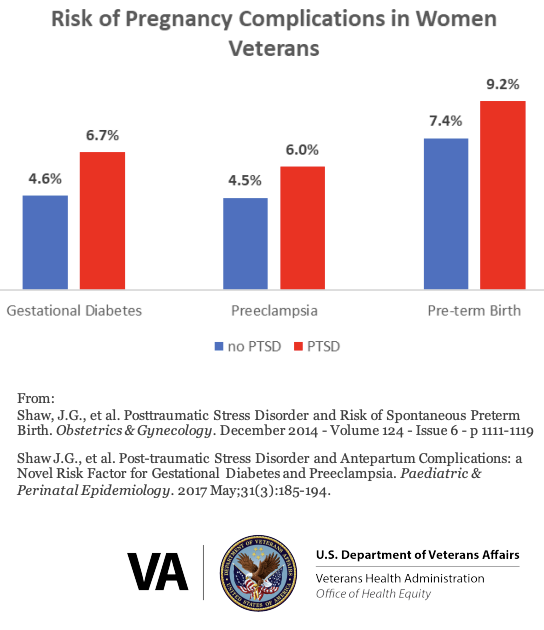
    VA research shows that women who experienced MST had an increased risk of spontaneous preterm birth, preeclampsia and gestational diabetes. 

    Dr. Kelsey Sprang Jones with Emory University School of Medicine told WABE that maternal trauma can also harm babies.

    In Georgia, mental health conditions are among the leading causes of pregnancy complications and maternal deaths. The risks are even higher for women veterans who have post-traumatic stress disorder.

    A chart showing the increase in pregnancy complication risk for women veteran who have experienced military sexual trauma

  • GDOT plans another weekend closure of I-285 for major reconstruction work

    GDOT plans another weekend closure of I-285 for major reconstruction work

    GDOT plans another weekend closure of I-285 for major reconstruction work

    The Georgia Department of Transportation (GDOT) plans another closure of Interstate 285 in June for another round of construction.

    The agency plans to close the roadway starting at 7 p.m. on Friday, June 5, and running until 5 a.m. on Monday, June 8, as long as weather allows for construction.

    The closure will be for the same stretch of road that was closed earlier this month: between Martin Luther King Jr. Drive and Cascade Road in Fulton County.

    Kysii Ingram, owner of Cafe Bartique, said the closure severely impacted his business on Cascade Road.

    “We felt a reduction of business because there was so much traffic due to the shutdown on Cascade and MLK,” he said.

    Usually, Saturday and Sunday are their busiest days at the coffee shop, but Ingram said they only saw a few customers that weekend.

    The construction is part of the I-285 Westside reconstruction project that will replace concrete slabs on a 10 mile stretch costing around $206 million.

    Natalie Dale, a spokesperson for GDOT, explained the reason for the construction.

    “These concrete slabs are almost 60 years old, and so they are well past their lifespan, and in order to really bring the structure and the safety, the stability to this roadway that has been needed, we need to rebuild the entire stretch,” she said.

    Detours will be established during the closure, and drivers can call 511 for current travel information.

  • Georgia energy leaders discuss data centers and future power demands

    Georgia energy leaders discuss data centers and future power demands

    Georgia energy leaders discuss data centers and future power demands

    The Georgia Chamber of Commerce held its first “State of Energy” event at the Coca-Cola headquarters in downtown Atlanta.

    Key speakers at the event included leaders from Kia Georgia, Georgia Power and the Chamber, and more attended the event from the energy sector to discuss how Georgia will fuel its future.

    One of the most pressing topics discussed was the rapid expansion of data centers in the state and the impact on energy infrastructure.

    Georgia Chamber of Commerce President and CEO Chris Clark argued that the industry is actively adapting to mitigate its environmental impacts and denied, what he called, common misconceptions about the industry.

    “In Georgia, those data centers pay their own way,” Clark said. “You and I don’t pick up the tab for those data centers from an energy standpoint. They have to come in, they have to put their dollars down, they have to pay a higher rate, and if something goes wrong in the grid, they go down, our power stays on.”

    Either way, Clark said data centers are here to stay.

    “They are part of our modern infrastructure,” Clark said. “They’re part of a national security issue, and they’re here because of consumer demand. And so if people don’t like them, then let’s quit storing our photos online and quit connecting to the internet to do everything.”

    Further, Clark argued that the tech giants are providing the resources for major utility overhauls in the state. The Chamber represents Georgia business interests, and although Clark said they acknowledge community concerns about data centers, he sees the economic impact of the centers as a positive outcome.