-
 play_arrow
Georgia NOW Live Streaming Now
-
 play_arrow
The Politics Bar After Hours - The Benchers



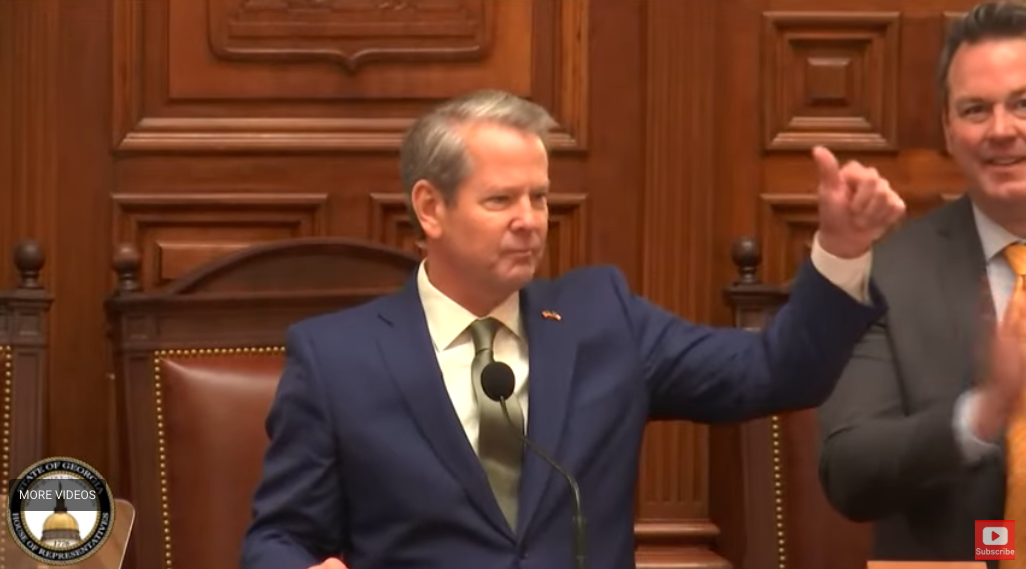
Gov. Brian Kemp gives the audience a thumbs up at his final State of the State address Thursday at the Georgia State Capitol. Credit: Georgia House of Representatives Livestream.
Kemp orders state agencies to hold spending steady amid tax cuts
Gov. Brian Kemp is directing state agencies to keep their spending at stable levels as Kemp prepares to leave office and as the state reduces income taxes.
A memo was sent in July instructing agencies to maintain their current spending levels. Richard Dunn, the director of the Georgia Office of Planning and Budget, sent the memo saying the move was necessary to ensure development in the state continues while also accommodating for the recent reduction in the state’s income tax.
“To sustain these achievements while implementing historic tax relief for our citizens, responsible fiscal management principles require that we continue to live within our means,” the memo reads.
Republican state Sen. Blake Tillery, chairman of the Georgia Senate Appropriations Committee and a large supporter of eliminating the state income tax, told Atlanta News First that the state is coming down from a pandemic-era high.
“All that sugar high has finally bled out of the system, and you’re seeing a return to normal on state revenues,” he said.
Democrat state Sen. Reshaun Kemp told Atlanta News First that freezing the budget impacts education and health care the most.
“While we continue to see hospitals close and students that are languishing in their education, we should not be cutting or freezing spending,” he said.
Kemp signed the Georgia Economic Growth and Tax Relief Act in May to reduce Georgia’s state income tax from 5.19% to 4.99%. The law allows for an annual reduction of 0.125% until the rate reaches 3.99% as well as increased the standard deduction for single and married filers.
To offset the cost of the decrease and the recent suspension of the gas tax, Kemp cut $300 million from the state’s $36.6 billion budget, including from agencies like the Department of Community Health and the Department of Behavioral Health and Developmental Disabilities.
Dunn wrote that agencies should prepare for additional cuts by making contingency plans for the worst-case scenario.

-

Jill on Money
Saturdays at 9am
Jill on Money is a nationally syndicated radio show and podcast hosted by Jill Schlesinger, CFP®, the Emmy and Gracie Award-winning business analyst for CBS News who tackles sometimes uncomfortable and even controversial money and investing issues without the financial jargon. Each week, Jill takes listener phone calls and interviews informative and entertaining guests to uncover surprising insights and provide actionable information so listeners can make the most of their money. Jill translates complicated business and economic news into understandable, relatable topics, is a weekly guest on NPR's "Here and Now," and writes the nationally syndicated column "Jill on Money" for Tribune Media Services. Her two books include The Great Money Reset, published in January 2023 by St. Martin's Press, and The Dumb Things Smart People Do With Their Money, published in February 2019 by Ballantine Books.
close  From CBS News
- At least 4 dead as Isaias brings threat of floods across the Southeast October 10, 2026More than 600,000 customers are without power after Isaias made landfall as a hurricane on the northern Gulf Coast.
- Vehicle driven by ICE agents in Texas hits and injures man, sheriff says October 10, 2026The Harris County Sheriff's Office said in a statement that the incident appears to have occurred during an ICE enforcement action.
- House candidate who reported rape on campaign trail details why she came forward October 10, 2026In the days since U.S. House candidate Bernadette Greene-Placentia publicly came forward alleging she was raped over the summer while repairing a campaign sign, she says women have been reaching out to her to share their own stories.
- This week on "Sunday Morning" (Oct. 11) October 10, 2026A look at the features for this week's broadcast of the Emmy-winning program, hosted by Jane Pauley.
- Christa Pike released from hospital following botched execution, lawyers say October 10, 2026Christa Pike survived despite being given two doses of a lethal injection.
- Pope says death penalty "inadmissible" amid U.S. plans to livestream execution October 10, 2026The firing squad execution of Nidal Malik Hasan, convicted of a 2009 shooting at Fort Hood, will be livestreamed, the U.S. Defense Department said.
- What we know about the man shot by ICE in New York City October 10, 2026There's outrage in New York City after a Bronx man was shot by an Immigration and Customs Enforcement agent while his young child sat in the backseat of his car. The Department of Homeland Security says the man "decided to not comply with lawful orders." Camilo Montoya-Galvez reports.
- Isaias makes landfall as Category 2 hurricane October 10, 2026Isaias made landfall on the northern Gulf Coast as a Category 2 hurricane, but within hours weakened to a post-tropical cyclone.
- Blanche, other DOJ appointees can take part in campaigns, memo says October 10, 2026The Justice Department has loosened the guidelines for the attorney general and other senior political appointees, allowing them to participate in political activities.
- 10/10: CBS Saturday Morning October 10, 2026Isaias makes landfall, President Trump's Russian diesel deal, plus the search for Amelia Earhart. All this and more.
- At least 4 dead as Isaias brings threat of floods across the Southeast October 10, 2026
Post comments (0)