-
 play_arrow
Georgia NOW Live Streaming Now



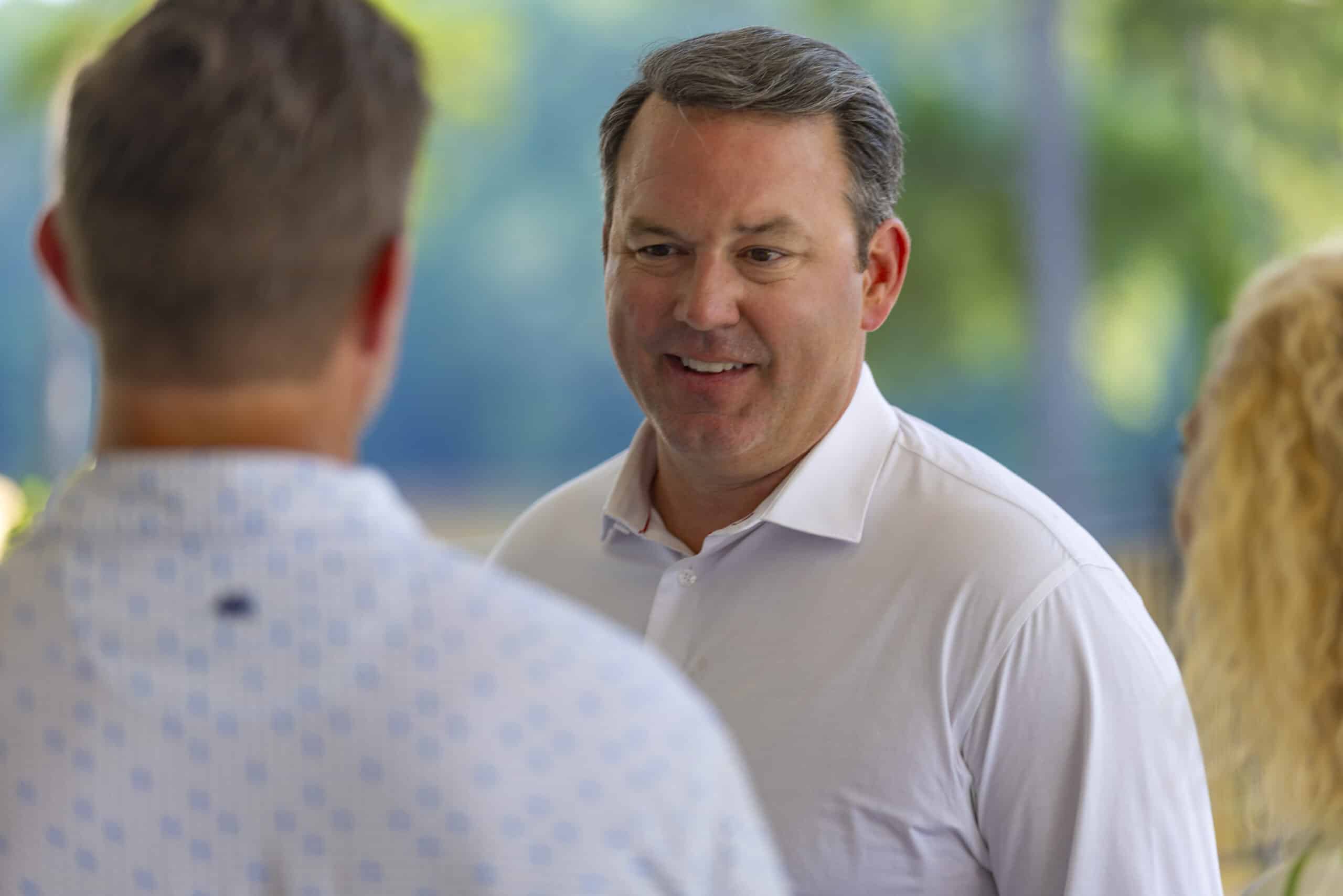
Lt. Gov. Burt Jones is running for the governor's seat in 2026. Credit: Burt Jones' campaign website.
Georgia’s leadership committees fuel high-dollar arms race in 2026 governor’s race
A $526,000 donation from an anti-tax political group to Lt. Gov. Burt Jones underscores how Georgia’s powerful “leadership committees” are reshaping the 2026 governor’s race — fueling a financial arms race and triggering fresh legal challenges.
According to the Atlanta-Journal Constitution, just days before unveiling details of his proposed income tax overhaul, Jones received the largest single contribution his leadership committee has reported: a $526,000 check from Fighting for Georgians on Jan. 29, during the opening weeks of the legislative session. It ranks among the biggest donations to a leadership committee since lawmakers authorized the fundraising vehicles in 2021.
Jones has collected roughly $2.7 million through his leadership committee since July 2025. Unlike traditional campaign accounts, leadership committees can raise unlimited sums from donors, including corporations and political action committees, and can coordinate directly with a candidate’s campaign. The structure has transformed Georgia politics by allowing top statewide officials and legislative leaders to amass enormous reserves.
Jones is one of four major Republicans competing for the 2026 nomination, alongside Attorney General Chris Carr, Secretary of State Brad Raffensperger and businessman Rick Jackson. While candidates are barred from raising money during the 40-day legislative session for their campaign committees, leadership committees can continue collecting contributions — giving officeholders a significant edge.
Gov. Brian Kemp’s leadership committee illustrates the scale of the system. Though he is not on the 2026 ballot, Kemp’s committee holds more than $2.3 million. Since 2021, his leadership committee has raised more than $15 million and played a central role in advancing his policy agenda, financing political allies and reshaping state politics.
Democrats and Republicans alike have embraced the structure. Georgia House and Senate Republicans reported about $2.8 million combined in leadership funds during the latest reporting period. House Democrats’ leadership committee reported roughly $185,000 in contributions, including $20,000 from AT&T and $300,000 from Walmart’s political arm.
An Atlanta Journal-Constitution analysis of newly released reports found leadership committees raised more than $3.2 million during January 2025 alone. Since July, these entities have reported raising millions more — far exceeding what traditional campaign accounts can collect during similar periods.
Critics argue the system gives insiders an overwhelming financial advantage. Raffensperger has filed a lawsuit seeking to dismantle the leadership committee structure, arguing it creates an uneven playing field and favors certain candidates — particularly Jones, who can leverage his role as lieutenant governor to raise unlimited funds while rivals face tighter restrictions.
The lawsuit has drawn resistance from fellow Republicans. A spokesperson for Jones dismissed the challenge as politically motivated, while Kemp and other GOP leaders have defended the system as legal and transparent. Courts have so far declined to block the fundraising framework, though legal fights are ongoing.
Jones has drawn support from a range of major donors and industries, including construction firms, real estate interests, tobacco giant R.J. Reynolds, and Newnan-based betting company Brentwood Associates. Records show six-figure contributions from corporate and advocacy groups. Expenditures include payments tied to family business interests, aviation services, office expenses and other operational costs.
Fighting for Georgians — the anti-tax organization behind the $526,000 contribution — has emerged as a key outside ally. The group strongly supports Jones’ push to eliminate Georgia’s income tax and has described its mission as promoting smaller government and economic growth. During the 2024 election cycle, it backed candidates aligned with reducing income taxes and repealing certain property taxes.
Public records show the organization lists an Atlanta office address that carries signage for “PhysicalAddress.com.” Attempts to reach the group for comment were unsuccessful. Its executive director did not respond to inquiries.
The AJC reports that Jones’ tax plan would eliminate certain tax breaks and lower the state income tax rate as part of a broader restructuring. The proposal aligns closely with Fighting for Georgians’ agenda and has won support from key Senate allies. The Senate recently advanced income tax legislation largely along party lines.
The escalating financial competition signals that the 2026 Republican primary could become one of the most expensive statewide races in Georgia history. Candidates are already pouring personal funds and outside contributions into early positioning. Businessman Rick Jackson has committed at least $50 million of his own wealth toward his bid. Raffensperger has leaned on personal funds and outside donors, while Carr has built a traditional campaign operation while backing legal efforts to curb the leadership committee system.
The leadership committee structure has blurred lines between governing and campaigning, enabling officeholders to fundraise aggressively while shaping policy. Supporters say the committees provide flexibility and strengthen party infrastructure. According to the AJC, critics warn they erode campaign finance limits and deepen the influence of wealthy donors and corporate interests.
With months remaining before the 2026 primary intensifies, the unlimited money machine shows no signs of slowing — and neither do the legal and political battles surrounding it.

-

The Stephanie Miller Show
Weekdays at 10am
National morning drive radio and television star Stephanie Miller hosts The Stephanie Miller Show, reaching over six million listeners weekly on satellite and terrestrial radio, simulcast on FreeSpeech TV. A ratings powerhouse who dominated at KABC, KFI, and stations in New York and Chicago, she's been ranked on Talkers Magazine's "Heavy Hundred" for over a decade and won their Woman of the Year Award. Her sold-out Sexy Liberal Comedy Tour became the fastest-selling comedy tour in history, earning three Pollstar nominations and producing America's #1 comedy album. Praised by Rachel Maddow as "the high priestess of excellent liberal talk" and by Carol Burnett as "the Carol Burnett of radio," this Liberal icon—ironically the daughter of Barry Goldwater's 1964 VP running mate—is known as "The Voice of The Resistance."
close  From CBS News
- CNN, MS NOW and Politico sue to restore White House access September 21, 2026The three news organizations, which were banned from White House grounds by President Trump, are arguing that the ban is unconstitutional.
- No network TV coverage on Trump amid his unprecedented media ban September 21, 2026President Trump met with the New York City Mayor Zohran Mamdani on Monday and was also preparing for Tuesday's UN General Assembly. But the president is also in the middle of a fight with the media, making it difficult to cover any of that as business as usual. Ed O'Keefe reports.
- Thousands of flights canceled after FAA systems went down September 21, 2026More than 6,000 flights were canceled or delayed coast to coast because a construction crew accidentally severed a backup data cable from a radar facility near Philadelphia. The first line had already failed. Kris Van Cleave has more details.
- Man shot by ICE being detained with bullet still in his back, lawyer says September 21, 2026Wilber Rafael Garces Perez, the 28-year-old Venezuelan national shot by an ICE officer on Sunday, said in a phone call on Monday that he's "not doing well."
- This week on "Sunday Morning" (Sept. 20) September 21, 2026A look at the features for this week's broadcast of the Emmy-winning program, hosted by Jane Pauley.
- Lindsay Clancy's attorney requests investigation into holdout juror September 21, 2026Lindsay Clancy's lawyers asked a judge to question the holdout juror about his alleged use of a cellphone during deliberations and his truthfulness on a jury questionnaire.
- Paramount Skydance reaches antitrust deal with states over Warner Bros. Discovery purchase September 21, 2026Paramount's agreement with 12 state attorneys general paves the way for the company to complete its $110 billion acquisition of Warner Bros. Discovery.
- Selling early access to Trump Truth Social posts is illegal, ex-prosecutors say September 21, 2026Trump Media & Technology recently launched a Truth Social API data feed, charging $100,000 for "real-time access to posts from the highest-ranking Truth Social accounts."
- Converse pulls sneaker ad after critics say it uses racist imagery September 21, 2026Nike-owned Converse acknowledged that an ad for its Chuck Taylor sneaker is "deeply upsetting."
- Presidential TV pool suspended after Trump bans CNN September 21, 2026CNN was set to provide pool coverage on Monday and accompany President Trump on a trip to New York City, but there will not be a network TV pool team traveling with him.
- CNN, MS NOW and Politico sue to restore White House access September 21, 2026
Post comments (0)