-
 play_arrow
Georgia NOW Live Streaming Now
-
 play_arrow
The Politics Bar After Hours - The Benchers



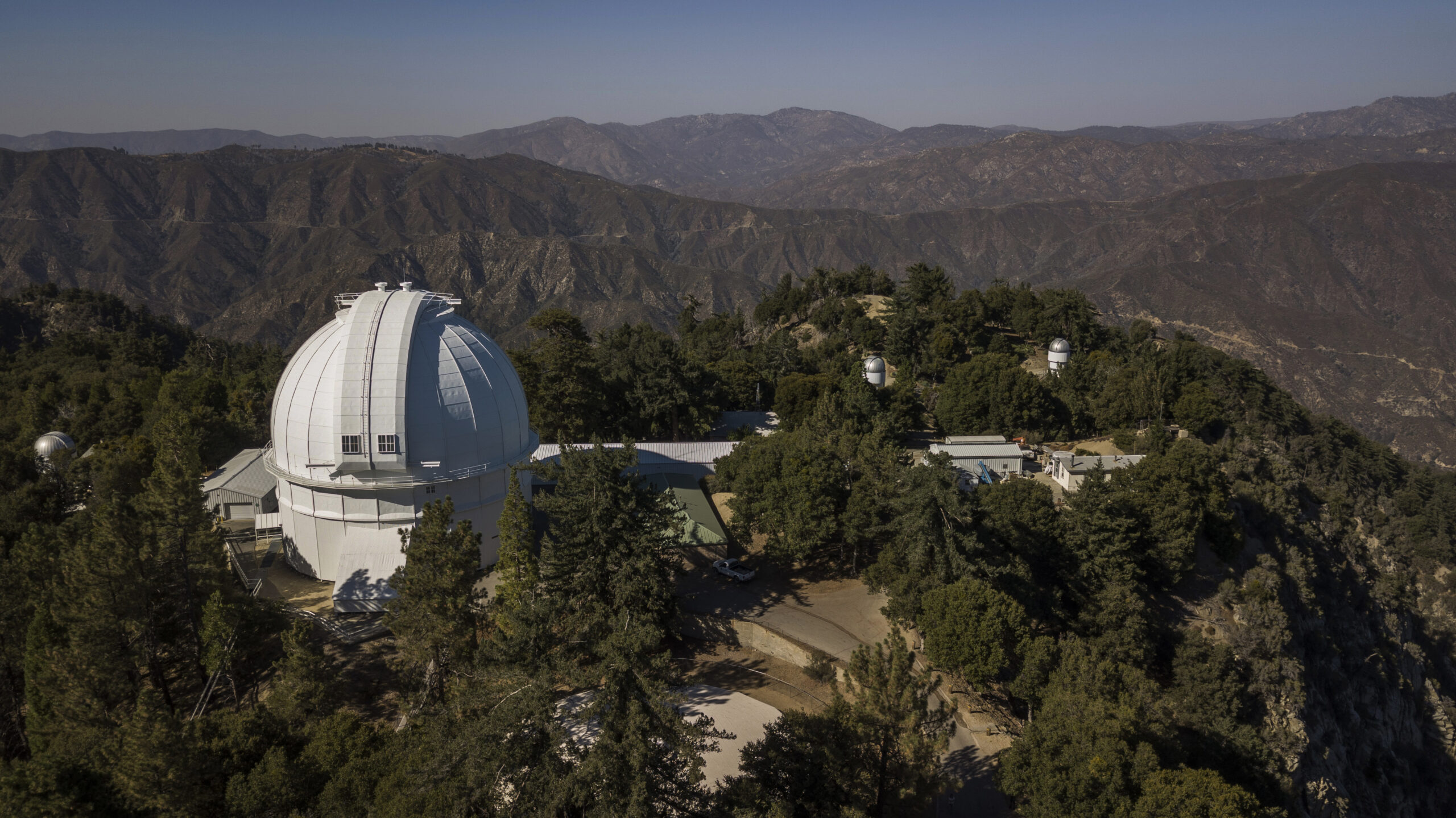
The CHARA Array, which is managed by Georgia State University, is located at the Mount Wilson Observatory in the San Gabriel Mountains in California. Credit: Georgia State University.
Georgia State telescopes capture rare star explosions in groundbreaking study
An international study published in December will help scientists understand the life cycle of stars.
The study published in the journal Nature Astronomy used Georgia State University equipment at the Center for High Angular Resolution Astronomy (CHARA) to capture images of two stars exploding with unprecedented clarity, according to Georgia Public Broadcasting.
The CHARA array uses six telescopes, and CHARA Director Gail Schaefer told GPB the array is limited.
“To catch these nova explosions, you need a combination of something that’s actually a very bright explosion, like angularly,” she said. “So the nova has to be relatively close to us for it to appear bright enough that we can actually see it with a CHARA array.”
During this study, scientists were able to observe various stages of the explosions, and Schaefer said although the first star exploded very quickly, the second star took its time.
“The second one that we caught that year, it was a very slowly evolving nova,” she said. “For that one, it took about 50 days before, like, the outer layers kind of exploded outward.”
The findings challenge the long-held belief that star explosions happen abruptly and provide evidence that they have multiple paths of development, according to a news release.
“This is just the beginning,” said Elias Aydi, lead author of the study and a professor of physics and astronomy at Texas Tech University, in the news release. “With more observations like these, we can finally start answering big questions about how stars live, die and affect their surroundings. Novae, once seen as simple explosions, are turning out to be much richer and more fascinating than we imagined.”


-

The Stephanie Miller Show
Weekdays at 10am
National morning drive radio and television star Stephanie Miller hosts The Stephanie Miller Show, reaching over six million listeners weekly on satellite and terrestrial radio, simulcast on FreeSpeech TV. A ratings powerhouse who dominated at KABC, KFI, and stations in New York and Chicago, she's been ranked on Talkers Magazine's "Heavy Hundred" for over a decade and won their Woman of the Year Award. Her sold-out Sexy Liberal Comedy Tour became the fastest-selling comedy tour in history, earning three Pollstar nominations and producing America's #1 comedy album. Praised by Rachel Maddow as "the high priestess of excellent liberal talk" and by Carol Burnett as "the Carol Burnett of radio," this Liberal icon—ironically the daughter of Barry Goldwater's 1964 VP running mate—is known as "The Voice of The Resistance."
close  From CBS News
- Trump administration ordered to cancel taxpayer-funded TV ads October 12, 2026The Department of Homeland Security tapped $20 million in taxpayer money for the ads, which the White House has defended as public service announcements.
- Thousands still without power in Florida and Alabama as Isaias moves north October 12, 2026The storm, which hit as a Category 2 hurricane near Destin, Florida, has been linked to at least four deaths.
- The real story behind Winnie the Pooh, born in the shadow of WWI October 12, 2026When soldiers of World War I traveled to Europe to fight, they would bring real animals meant to lift their spirits. One of them was an orphaned black bear from Canada. Tina Kraus explains how the cub inspired Winnie the Pooh, now 100 years old.
- As high diesel prices hit Great Plains, some considering all options in midterms October 12, 2026Republicans have dominated elections in Great Plains states for a generation. But with the midterms fast approaching, Ed O'Keefe reports that some voters in Iowa now say they're considering all of their options.
- Yemen's Houthis target King Khalid airport in Saudi Arabia again October 12, 2026Tensions flared in the Middle East following attacks by Iran-backed Houthi rebels on Saudi Arabia. Leigh Kiniry reports.
- Trump announces Russia-Ukraine energy ceasefire, Russia later strikes Ukraine October 12, 2026President Trump announced that he struck an energy ceasefire with Ukraine and Russia. Hours later, the Russians hit a neighborhood in the Ukrainian city of Kharkiv, including a power plant. It follows new criticism for the president's diesel deal with Russia. Taurean Small reports from the White House.
- Tropical Storm Rachel devastates homes in California: "We've never seen anything like this" October 12, 2026Tropical Storm Rachel caused devastation along the waterfront in Long Beach, California. Akiko Fujita reports and Grant Gilmore has the forecast.
- A look at Hurricane Isaias damage after unleashing flooding, tornadoes October 11, 2026The first hurricane of the 2026 Atlantic season roared into Florida late Friday, unleashing destructive winds, extensive flooding and spinning up tornadoes across the Southeast. Jason Allen reports on the damage.
- 0/11/2026: In the Line of Fire; Lost Sheep; Jon Batiste October 11, 2026First, an inside look at Secret Service operations. Then, reporting on West Bank settler violence. And, Jon Batiste: The 60 Minutes Interview.
- 10/11: CBS Weekend News October 11, 2026Deadly Isaias barrels north; Tropical Storm Rachel remnants soak the West.
- Trump administration ordered to cancel taxpayer-funded TV ads October 12, 2026
Post comments (0)