-
 play_arrow
Georgia NOW Live Streaming Now
-
 play_arrow
When They Show You Who They Are



Emory’s Carlos Museum presents “Continuum” exhibit featuring Mvskoke artists Johnnie Diacon, Hotvlkuce Harjo

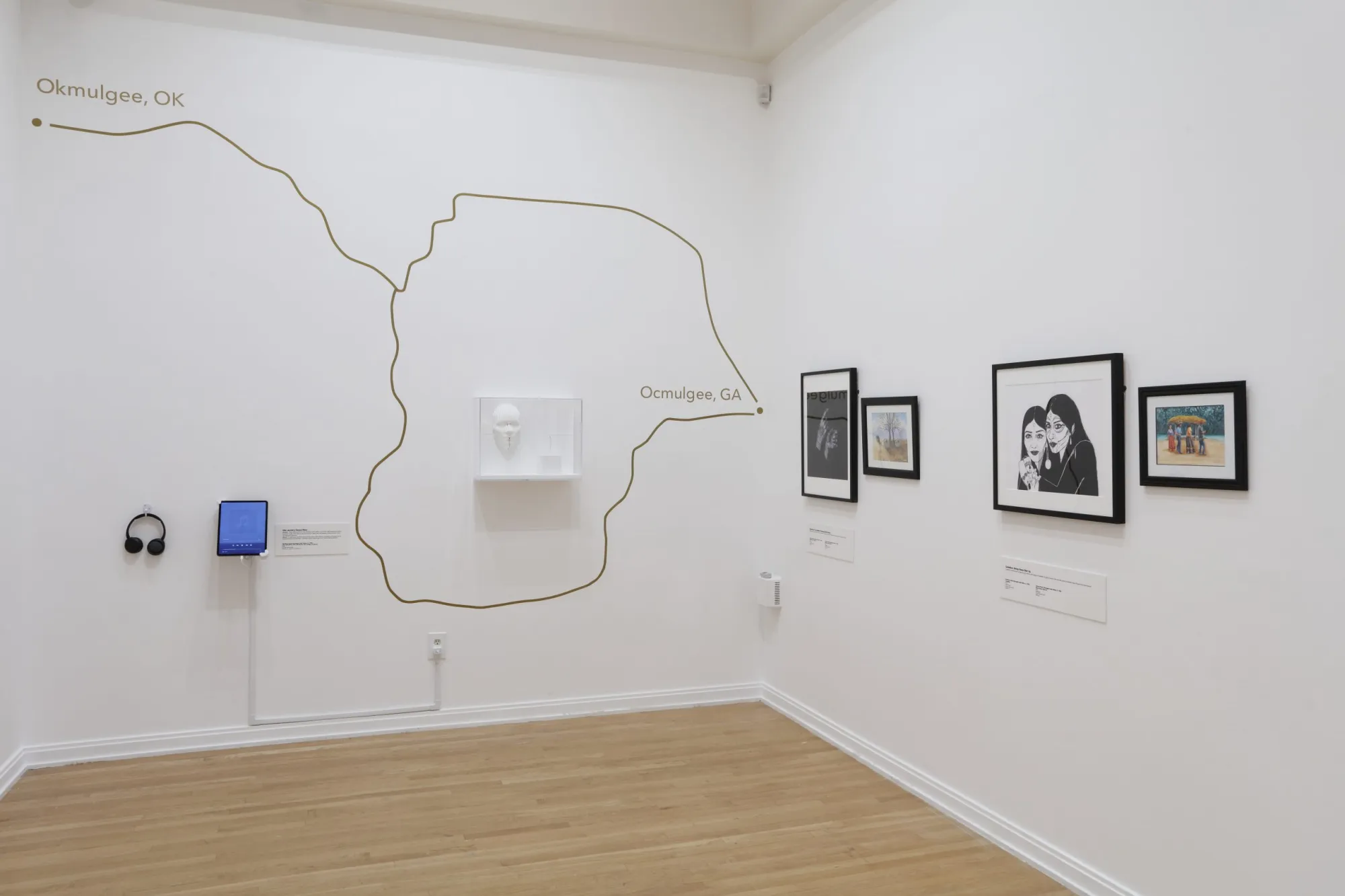
Gallery wall featuring a map connecting Okmulgee, Oklahoma, and Ocmulgee, Georgia, alongside framed artworks and Harjo’s audio station. (Image by Mike Jensen)
Carlos Museum exhibition spotlights Mvskoke art and history in Atlanta
The Michael C. Carlos Museum at Emory University is presenting “Continuum,” an exhibition highlighting work by two Mvskoke Nation artists and examining how Indigenous history is represented in Atlanta. Rough Draft reports the exhibition is on view through Dec. 7 and will move to Emory’s Oxford campus for the 2026 academic year.
The show includes more than 20 pieces by artists Johnnie Diacon and Hotvlkuce Harjo. Their work spans watercolor, ink, painting, jewelry and sound. According to Miranda Kyle, curator of Indigenous Arts of the Americas at the museum, the project was designed to challenge the common practice of beginning Atlanta’s historical timeline around the Civil War.
“Atlanta tends to start history around the Civil War, and frame and fix Indigenous peoples as parts of a past history,” Kyle told Rough Draft.
“This exhibition is intended to lend its voice to the rising tide of individuals and organizations, activists and communities calling for and working to re-educate the South on the Indigenous history and contemporary life of the peoples who have been displaced from their homelands.”
Kyle refers to “Continuum” as a “re-presencing” because the exhibition focuses on the ongoing contributions of Mvskoke people rather than presenting them solely in historical terms. The show incorporates a framework from Dr. Laura Harjo’s book Spiral to the Stars, which describes Mvskoke creativity as existing across time rather than in a linear sequence.
Visitors will encounter a large map connecting Ocmulgee in Georgia to Okmulgee in Oklahoma, reflecting the history of forced removal and present-day ties. Harjo also created an audio component accessible through headphones in the gallery. Kyle recommends visitors move through the gallery once on their own, then again while listening to Harjo’s soundscape.
Harjo’s work includes detailed ink drawings and portraits of young Mvskoke women, as well as a piece depicting traditional medicine practices. Kyle said the exhibition places the two artists’ works in conversation across generations.
Diacon’s pieces cover a range of subjects, including Mvskoke daily life and the role of Mvskoke code talkers during the Aleutian Islands campaign in World War II. He noted that exhibiting in Atlanta, within Mvskoke ancestral homelands, is significant to him.
“It’s always an extreme honor to represent our Mvskoke people with my art, especially in our ancestral homelands,” Diacon told Rough Draft.
“Continuum” aligns with Emory’s broader Native American and Indigenous Studies Initiative, supported by the Mellon Foundation. The initiative includes language instruction, curriculum development with the College of the Mvskoke Nation, and an annual teach-in. During Kyle’s tenure, the museum also has increased its acquisition of contemporary Southeastern Indigenous art.
The exhibition is open to the public and aims to provide additional context on Mvskoke history and present-day cultural expression.


-

The Thom Hartmann Program
Weekdays at 1pm
Thom Hartmann is a New York Times bestselling, four-times Project Censored Award-winning author and host of The Thom Hartmann Program, which broadcasts live nationwide each weekday from noon to 3pm Eastern. For 20 years, the show has reached audiences across AM/FM stations throughout the US, on SiriusXM satellite radio, and as video on Free Speech TV, YouTube, Facebook, and X/Twitter.
close  From CBS News
- DOJ demands that some California counties set aside alleged noncitizen ballots October 24, 2026Federal prosecutors sent letters to county registrars across California demanding that local officials set aside and verify ballots that the Justice Department said may belong to noncitizens.
- DOJ sues to block Alaska Senate certification if Sullivan loses October 24, 2026The Trump administration is suing to prevent the Alaska Senate election from being certified if GOP Sen. Daniel Sullivan loses to Democrat Mary Peltola because of the other Dan Sullivan who is on the ballot.
- Roller coaster safety experts weigh in on Six Flags investigation October 24, 2026The Goliath roller coaster at Six Flags Over Georgia has been closed since a man died after witnesses say he was ejected from the ride.
- Indiana school bus driver gets children out of bus just before it goes up in flames October 24, 2026An Indiana resident captured footage of the moment when a school bus was consumed by flames, leaving only the frame, just after the student passengers were let out. Tom Hanson has the details.
- "The Kindness Mob" has come to the rescue of hundreds of online bullying victims October 24, 2026Started in 2023, "The Kindness Mob" is a group about half a million strong that secretly battles internet spite.
- Hero dad who stopped Oregon school shooter shares his story October 23, 202636-year-old Kaylub Giamanco shared his story with Oregon Public Broadcasting a week after the school shooting that killed three children and a teacher.
- Police officer who shot and killed 1-year-old resigns October 23, 2026The Mississippi attorney general's office had determined that the use of force was justified in the deadly shooting that stemmed from an alleged shoplifting incident.
- Colorado, Utah contend with heavy flooding October 23, 2026Multiple states are dealing with severe weather, including flooding and gusty winds. Rob Marciano has the details.
- House hunter discovers body in vacant home October 23, 2026In an exclusive interview, a homebuyer shares vivid details of finding a dead man during a house tour.
- Judge allows Jane Doe anonymity in Cornell sexual assault lawsuit October 23, 2026Jane Doe can remain anonymous in her sexual assault lawsuit involving former members of Cornell University's Chi Phi fraternity, a judge ruled.
- DOJ demands that some California counties set aside alleged noncitizen ballots October 24, 2026
Post comments (0)