Author: Jenna Eason

  • Georgia lawmaker pushes rent reform, targets hidden fees and AI pricing

    Georgia lawmaker pushes rent reform, targets hidden fees and AI pricing

    Georgia lawmaker pushes rent reform, targets hidden fees and AI pricing

    In a tirade of affordability legislation, state Rep. Gabriel Sanchez, D-Smyrna, has garnered support and introduced several pieces of legislation to address housing affordability issues and protect renters.

    Sanchez recently introduced House Bill 1188, which would prohibit landlords from withholding the full rental price of a property and from charging hidden fees. The goal of the legislation is to increase transparency and fairness in residential rent pricing, according to the news release.

    “Georgia is one of the worst states to be a renter, and hidden fees only deepen housing insecurity for working class people,” Sanchez said in the release.

    In an interview with Sanchez, he said he is continuing his work on housing bills from the last legislative session.

    “We introduced last year House Bill 679 in particular, which got a hearing, which bans the use of AI software to artificially increase rents, which has been a huge issue, especially here in Georgia, including my own apartment complex that I live in,” he said.

    House Bill 864 would require more transparency from corporations about their ownership of single-family homes, and Sanchez said the bill would end ownership of single-family homes by major corporations.

    “I mean, obviously people are really, really struggling right now,” Sanchez said. “We have to make systemic change and have a government that actually works for the people, not just those at the top.”

    House Bill 1188 and 679 have been referred to the Judiciary Committee, and House Bill 864 has been referred to the Governmental Affairs Committee.

    “There’s a lot of work that needs to be done to take back our government and make it actually representative of the people and create a government and economy that works for all of us,” he said.
  • Weekend storm brings fire relief, cleaner air to South Georgia

    Weekend storm brings fire relief, cleaner air to South Georgia

    Weekend storm brings fire relief, cleaner air to South Georgia

    Although a weekend storm system brought some tumultuous weather to South Georgia, it also brought some much needed relief from wildfires. 

    South Georgians came through the weekend with few power outages, no reported injuries and far cleaner air to breath.

    On Friday, Albany and the surrounding areas faced a more than 200 on the air quality scale, which means the air is very unhealthy to breathe. An air quality level that high means everyone should try to avoid long, intense activities outdoors and move activities indoors when possible.

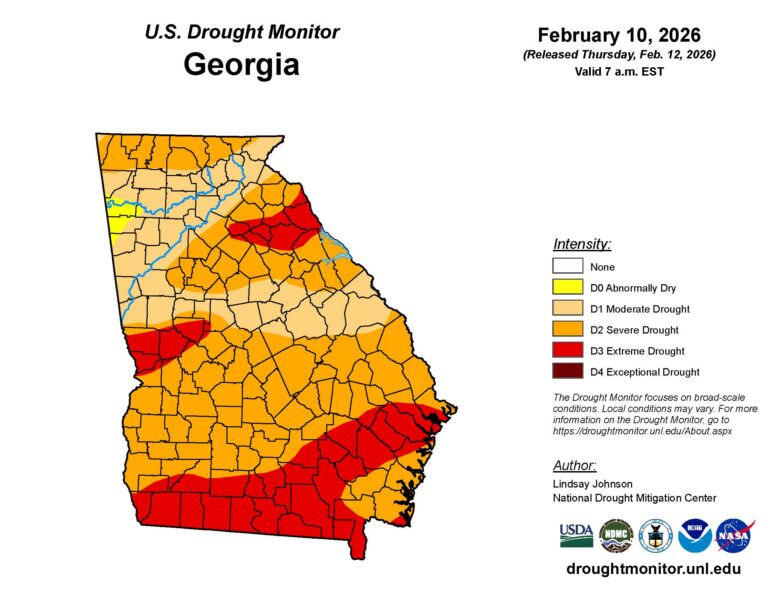
    South Georgia has been experiencing drought conditions the past few weeks resulting in wildfires and controlled burns causing a lot of smoke in the air.

    “With the drought conditions ongoing and with it being as dry as it is, it doesn’t take much to get a fire going in those areas, and then furthermore, the winds are very light today,” said Meteorologist Sid King with the National Weather Service on Friday. “So the smoke is just kind of settling and not really spreading.”

    Despite the relief from the rain this weekend, drought conditions are expected to persist in South Georgia, and soil moisture conditions remain extremely low for this time of year, according to the National Integrated Drought Information System.

    The end of winter to the early spring is typically the time of year for controlled burns by the U.S. Forestry Service and local farmers, but permits are typically only given if the weather conditions are acceptable.

    The U.S. Drought Monitor shows extreme drought conditions for areas of Georgia on Feb. 10. Credit: U.S. Drought Monitor.
    The U.S. Drought Monitor shows extreme drought conditions for areas of Georgia on Feb. 10. Credit: U.S. Drought Monitor.
  • DeKalb drops ICE resolution as state lawmakers push mask ban bill

    DeKalb drops ICE resolution as state lawmakers push mask ban bill

    DeKalb drops ICE resolution as state lawmakers push mask ban bill

    While local officials have backed down on regulations concerning federal immigration officials, state lawmakers are moving forward with proposing legislation.

    The DeKalb County Board of Commissioners voted to withdraw a resolution Tuesday that would demand Immigration and Customs Enforcement agents to end all tactical enforcement operations in residential areas of the county.

    DeKalb Commissioners Patrick, Johnson, Nicole Massiah and Mereda Davis Johnson all voted to withdraw the resolution.

    However, state lawmakers are pushing forward to get legislation on the General Assembly floor.

    State Rep. Gabriel Sanchez, D-Smyrna, said he is trying to get a hearing for House Bill 889, which would prohibit ICE officers from wearing masks and requires that ICE publicly identify themselves when doing their work. A similar bill, Senate Bill 389, has been read and referred to committee in the Senate.

    “Republicans have used this issue as a scapegoat to distract from their failures of leading the state, and so it is obviously clear that they are not interested in doing legislation to actually protect people’s rights, especially when it comes to immigrants,” he said. 

    Sanchez said he will continue talks with other lawmakers about having a hearing.

    “We’re not going to stop pushing for it and advocating for it,” he said. “If we can’t get it ourselves, we’ll make sure that they feel the pressure of the people and advocate for hearings in that manner, and if not, we’ll vote them out so we can actually have people who actually represent the people.”

  • Advocates push firearm limits as Georgia domestic violence deaths rise

    Advocates push firearm limits as Georgia domestic violence deaths rise

    Advocates push firearm limits as Georgia domestic violence deaths rise

    Fatality rates involving domestic violence are increasing in Georgia, and while Georgia Republicans look to establish an offender registry, activist groups are looking at different approaches.

    Karimah Dillard, the director of policy for the Georgia Coalition Against Domestic Violence, said the organization is looking at evidence-based approaches to address the issue.

    One key component is firearms because they are responsible for 80% of domestic violence deaths in Georgia.

    “Georgia, unlike the vast majority of the country, has nothing in our statute that compels the courts to restrict access to firearms for people who are subject to protective orders, which means that different jurisdictions around the state do different things,” Dillard said.

    States with these protections have seen a decrease in domestic violence deaths by 16%, Dillard said.

    The coalition is working with the Georgia Commission on Family Violence to establish a statewide danger risk assessment protocol for law enforcement to better identify those victims at the most risk.

    “This has been implemented in many other states around the country with a lot of success, and we would like to do that here in Georgia,” Dillard said.

    Another major issue for fighting domestic violence in the state is funding. The coalition is facing a $16 million reduction in funds from the end of federal programs and federal cuts.

    “We have been struggling to keep our domestic violence shelters and sexual assault centers funded so that they can continue to provide life-saving services to victims who seek out their services for help,” she said.

  • Proposed Georgia domestic violence registry draws debate

    Proposed Georgia domestic violence registry draws debate

    Proposed Georgia domestic violence registry draws debate

    Georgia Republicans announced a slew of bills last week to support Georgia families, including legislation to create a registry of domestic violence offenders.

    House Bill 1142 would create a time-limited, statewide domestic violence offender registry within the Georgia Bureau of Investigation.

    “Here in Georgia, we believe in second chances, but we will not ignore patterns of recurring violence, and we will prioritize the safety of women, children, and families every step of the way,” said Georgia House Speaker Jon Burns.

    In 2024, Georgia had 42,000 reported incidents of family violence and 159 confirmed deaths related to domestic violence.

    Burns also said the House’s amended 2026 budget includes a $4.5 million investment in domestic violence shelters and sexual assault centers in Georgia.

    “Placement on this registry sends a clear message that Georgia will not tolerate repeat domestic violence and that survivor safety comes first,” said state Rep. Leesa Hagan, R-Lyons.

    However, activists and survivors of domestic violence are not convinced this measure will help and believe it could cause more harm than good.

    Karimah Dillard, the director of policy for the Georgia Coalition Against Domestic Violence, said the fact that lawmakers are showing interest in the issue of domestic violence in Georgia gives her hope, but it’s a very complicated issue.

    “Some survivors say, ‘Yes, we really want it,’ and some survivors say, ‘No, we really don’t because there are lots of unintended consequences that could come from that,’” she said. “We are trying to honor both the survivors and advocates who want to do this and the survivors and advocates who don’t want to do this.”

    Advocates who do not support the bill expressed concerns about providing a false sense of security for people when they view the list, Dillard said.

    “Georgia has about a 31 to 33% arrest rate when it comes to family and dating violence, so most abusers are not going to be on this list,” she said.

    People might also lose their jobs if their name is on the list, and survivors of domestic violence might depend on that income for their children. Survivors might also be less likely to report domestic violence out of fear of retaliation from the perpetrator, Dillard said.

    What does the bill actually do?

    Dillard said the bill models legislation from Tennessee that went into effect in January.

    For people who have two convictions of domestic violence offenses, including family and dating violence convictions, their name would go on the registry for two years. Those with three convictions would have their name on the registry for five years, and those with four or more convictions would have their name on the registry for 10 years.

    The registry will include the name, date of birth, conviction date, county or counties  of convictions and a current photograph of each person on the registry.

    The goal of the bill is to reduce recidivism rates in Georgia, Dillard said, but the sex offender registry has not reduced recidivism.

    “The DV registry is not the same as the sex offender registry, so I don’t want to compare apples to apples,” she said. “We’re just kind of taking in all of this information and trying our best to understand what the best path forward is.”

  • Georgia Senate adds gender-affirming care limits to health bill

    Georgia Senate adds gender-affirming care limits to health bill

    Georgia Senate adds gender-affirming care limits to health bill

    A bill to increase access to home healthcare services has been transformed to restrict gender-affirming care for transgender Georgians.

    Republicans in the Georgia Senate added two last-minute amendments before passing the bill on party lines on Tuesday, according to WABE.

    The first amendment to House Bill 54 would prohibit doctors from prescribing puberty blockers to children diagnosed with gender dysphoria.

    State Sen. Ben Watson, R-Savannah, an internal medicine and geriatrics doctor, introduced the amendment and said it would not impact adults.

    However, the second amendment, introduced by state Sen. Blake Tillery, R-Vidalia, would prevent Georgia’s state health insurance from covering gender-affirming care for state employees and their dependents as well as preventing state hospitals from providing the care.

    Senate Democrats voiced their disapproval of the last-minute changes and criticized Republicans from straying from bipartisan, affordability policies.

    “Culture war bills are the easy things to do, to pick on vulnerable populations and try to distract your voters and the voters of Georgia from the failure of the Republican agenda in this country and in this state to deliver a good quality of life for Georgians,” said state Sen. Elena Parent, D-Atlanta.

    A similar bill to the second amendment, Senate Bill 39, failed to make it to a vote in the House last year.

    “They couldn’t get their divisive agenda across the finish line last year, so they doubled down on treating children and trans adults as less than,” Bentley Hudgins, the Georgia state director of the Human Rights Campaign, told The Georgia Recorder. “Bullies don’t belong in government.”

  • Oakwood officials blindsided by new ICE processing center plan

    Oakwood officials blindsided by new ICE processing center plan

    Oakwood officials blindsided by new ICE processing center plan

    Residents and officials of Social Circle have expressed their concern and disapproval of a U.S. Immigration and Customs Enforcement detention facility in their small town.

    As that fight seems to be lost, a new federal immigration facility has been announced for another Georgia town, Oakwood. The city of Hall County is located just 50 miles outside of Atlanta.

    Officials confirmed Tuesday that the Department of Homeland Security is set to acquire a warehouse to convert into an ICE processing center. The purchase is expected to be finalized in two weeks.

    City officials were completely caught off guard.

    “We were totally blindsided by ICE locating a facility here,” City Manager B.R. White told 11 Alive. “We didn’t receive official word until yesterday afternoon from Representative Andrew Clyde’s office telling us, yes, they are definitely coming here.”

    White said the facility is supposed to be a short-term processing facility that will house around 1,500 detainees before they are transferred to the larger warehouse in Social Circle.

    “There will be a cost. The cost to us will be supporting and defending the right to a peaceful assembly. We will guarantee that and our police force will work with whoever’s protesting in whatever capacity to make it safe for them,” said White.

    Around 150 people gathered at a city council meeting Monday and expressed their opposition to the plan, according to the Atlanta Journal-Constitution.

    “A city should not normalize the detention of human beings in a warehouse-style facility located down the road from neighborhoods, churches, schools and families,” said Ana Morales, who noted she lives near the warehouse.

  • Georgia hospitals plan for $218.8M in new rural health funds

    Georgia hospitals plan for $218.8M in new rural health funds

    Georgia hospitals plan for $218.8M in new rural health funds

    Healthcare professionals recently gathered at the Capitol to discuss how to use $218.8 million awarded to the state.

    Gov. Brian Kemp announced at the end of 2025 that Georgia had been awarded funds through the federal government’s Rural Health Transformation Program (RHTP).

    Now, hospitals will be able to apply for grant funds through the Georgia Department of Community Health to comply with the department’s vision for health care in Georgia, which is called Georgia’s Rural Enhancement and Transformation of Health (GREAT Health).

    Van Loskoski, CEO of Stephens County Hospital, told Georgia Public Broadcasting (GPB) that hospitals need funds for basic tasks.

    “We just, in the last two weeks, have had two events where we’ve had the shelter staff in place for an extended period of time with snowy and icy weather,” he said. “There’s funding built into this package that helps hospitals in emergency situations to shelter in place and to beef up their infrastructure so that they’re better prepared for these types of events.” 

    Hospital advocates listed several concerns that they would like to see the funds and lawmakers address, including an increasingly older population that relies heavily on Medicare, delays in getting payments from insurers, streamlining electronic medical records and improved technology to collect data on patient spending and needs, according to GPB.

    Critics of RHTP say the program fails to make up for the loss in federal funding to programs like Medicaid and the Affordable Care Act, and the funds may not get to the hospitals that need it the most.

    Caylee Noggle, president and CEO of the Georgia Hospital Association, told GPB she is confident the program will help target root challenges rural hospitals face.

    “We’re very, very appreciative and grateful for the increased focus on rural health care and some of the challenges,” she said. “And we’re hopeful that there are some real pieces in here that can prove to lead to longer-term innovation and support.” 

  • Georgia lawmakers move to shield ratepayers from data center costs

    Georgia lawmakers move to shield ratepayers from data center costs

    Georgia lawmakers move to shield ratepayers from data center costs

    Affordability is the buzzword this legislative session, and Georgia lawmakers are looking to protect consumers from higher utility bills due to data centers.

    Georgia House Bill 1063 would require electric utilities, such as Georgia Power, to protect residential and retail electricity customers from costs related to data center construction and operation.

    State Rep. Brad Thomas, R-Holly Springs, told The Capitol Beat lawmakers have heard concerns from their constituents about the costs associated with data centers, and he’s concerned that Georgia Power’s projected demand will not be realized.

    “We have heard that concern and we are going to address it,” Thomas said.

    Thomas presented the bill on Friday to the Special Committee on Resource Management, which passed it.

    Many of the requirements of the legislation are already required by Public Service Commission regulations, but codifying the measures add an additional layer of protections.

    “I like the fact that the PSC has a policy, but I also understand too that the PSC could change that policy at any time,” said state Rep. Teddy Reese, D-Columbus, at the meeting.

    Aaron Mitchell, the senior vice president of growth and engagement for Georgia Power, said that the company is neutral towards this bill because they are already implementing the requirements by the PSC.

    Environmental activists said they were not against the bill, but were concerned about some of the language in the legislation as not specifically defining costs to customers as well as concerns over Georgia Power’s predictions for electricity demands.

    An advocate for data centers did not reject the bill, but asked that the bill also include other large load customers.

    “This is probably the bill that will pass this year, I would imagine, relating to data centers,” said state Rep. Don Parsons, R-Marietta, at the meeting.

  • Fuel spill at Atlanta airport sends 10,000 gallons into Flint River

    Fuel spill at Atlanta airport sends 10,000 gallons into Flint River

    Fuel spill at Atlanta airport sends 10,000 gallons into Flint River

    • cover play_arrow

      Fuel spill from Atlanta airport contaminates Flint River

    Cleaning efforts are still underway after a fuel spill at Hartsfield-Jackson Atlanta International Airport dumped around 10,000 gallons of fuel into the airport storm water system and the Flint River.

    The U.S. Environmental Protection Agency reported that the fuel came from a fuel pit hydrant valve attached to a fuel system pipeline at the airport on Jan. 30.

    Gordon Rogers, the executive director and riverkeeper for Flint Riverkeeper, said it’s unclear exactly when the fuel spill started, and it’s also unclear how the spills actually get to the river.

    “But what is clear is that they shouldn’t be getting to the river. There should be some kind of secondary containment for all such accidents, and it’s quite clear that there is no containment because these spill volumes get to the river within a matter of hours,” he said.

    The Flint River has been the victim of at least nine spills in the past decade and also sewage releases and de-icing releases from the airport, he said.

    The riverkeeper has been working with the airport for more than a decade, and the issues they’ve raised should have been corrected by now, Rogers said. 

    “Our friendly approach is over at this point. We’re examining all of the different remedies that are available to citizen groups like Flint Riverkeeper. We’ve sort of had a bellyful of it,” he said. “There’s all sorts of different types of pollution that the airport is responsible for, but they’re doing very little, from what we can tell, to control it other than just lip service.”

    Rogers said they have sampled the water up to 65 miles downstream to get a better picture of the environmental costs of the pollution, but they have not received the results yet.

    They have found evidence of pollution up to 10 miles downstream so far, and they are advising residents to speak with their water providers to determine if they need to take special precautions with their water supply.

    In 2022, the airport was fined $40,000 for a fuel spill that discharged around 1,300 gallons of jet fuel into the river, impacting more than two miles of the river’s ecosystem.

    Fuel spills and other pollution from the airport can have immediate impacts on the environment by killing wildlife, but the long term impacts from chronic pollution reduce populations that the ecosystem depends on, such as insects and crawfish.

    “Pollution from the airport is chronic. It’s not fuel spills all the time, but it’s something all the time,” Rogers said.