-
 play_arrow
Georgia NOW Live Streaming Now
-
 play_arrow
The 'Georgia Diagnosis' - some bipartisan, some hyper-partisan: the Docter (Au) is in



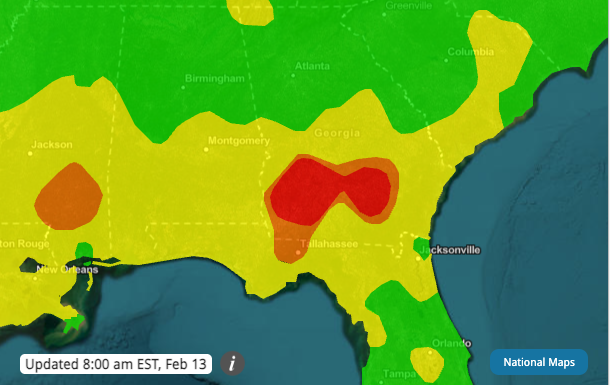
The Air Now air quality map shows unhealthy levels on Friday, Feb. 13. Credit: AirNow.gov.
Weekend storm brings fire relief, cleaner air to South Georgia
Although a weekend storm system brought some tumultuous weather to South Georgia, it also brought some much needed relief from wildfires.
South Georgians came through the weekend with few power outages, no reported injuries and far cleaner air to breath.
On Friday, Albany and the surrounding areas faced a more than 200 on the air quality scale, which means the air is very unhealthy to breathe. An air quality level that high means everyone should try to avoid long, intense activities outdoors and move activities indoors when possible.
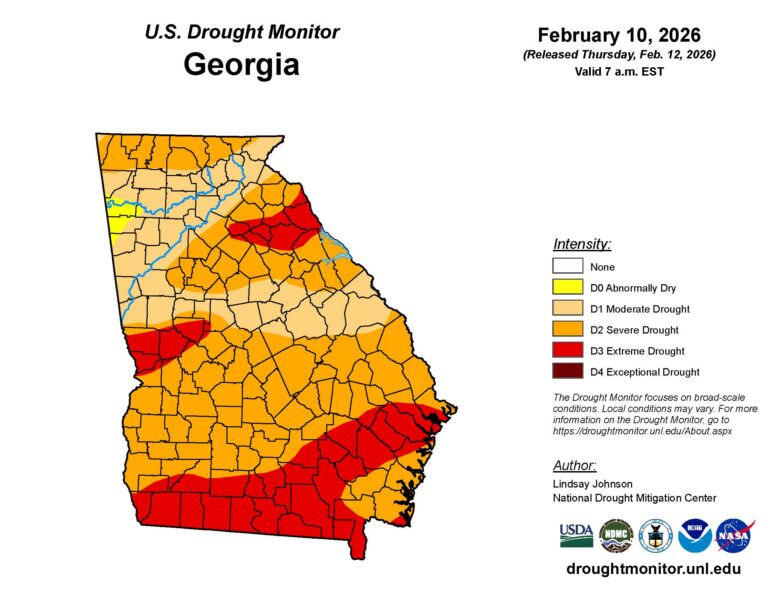
South Georgia has been experiencing drought conditions the past few weeks resulting in wildfires and controlled burns causing a lot of smoke in the air.
“With the drought conditions ongoing and with it being as dry as it is, it doesn’t take much to get a fire going in those areas, and then furthermore, the winds are very light today,” said Meteorologist Sid King with the National Weather Service on Friday. “So the smoke is just kind of settling and not really spreading.”
Despite the relief from the rain this weekend, drought conditions are expected to persist in South Georgia, and soil moisture conditions remain extremely low for this time of year, according to the National Integrated Drought Information System.
The end of winter to the early spring is typically the time of year for controlled burns by the U.S. Forestry Service and local farmers, but permits are typically only given if the weather conditions are acceptable.
-

The Ron Show
Weekdays at 4pm
Ron Roberts is a Georgia-born radio veteran and host of The Ron Show, Atlanta's only progressive audio platform airing weekdays on AmericaOne Radio. With an extensive background as an FM radio program director and broadcaster skilled in audio editing, voice acting, and commercials, Ron brings nearly three decades of radio experience to his show. The show covers Atlanta, metro Atlanta, Georgia, and national politics from a unique perspective—he's a self-described "run-of-the-mill Georgia-born gay progressive cat-dad realtor & talk show host". Ron frequently welcomes guests ranging from local activists to prominent national figures, including Marianne Williamson, Rep. Nikema Williams, actor Michael Kelly, and Sen. Shea Roberts.
close  From CBS News
- Shooting reported at high school hockey game in Pawtucket, Rhode Island February 16, 2026The ATF said it would assist police responding to reports of a shooting during a high school boys' hockey game in Pawtucket, Rhode Island.
- A timeline of Nancy Guthrie's disappearance as search stretches on February 16, 2026Savannah Guthrie's mom, Nancy Guthrie, was reported missing Feb. 1.
- "Signal sniffer" to detect Nancy Guthrie's pacemaker deployed, sources say February 16, 2026A device that can pick up certain electronic signals is being used in the search for Nancy Guthrie, as it may detect emissions from her pacemaker, sources told CBS News.
- Average tax refund is nearly 11% higher so far this year, IRS data shows February 16, 2026Forecasters predicted filers would benefit from larger checks this year due to a series of new tax provisions in the "one big, beautiful" bill.
- Why athleisure giant Lululemon is losing momentum February 16, 2026After a decade of rapid growth, Lululemon is struggling to find its footing in an increasingly saturated market.
- Robert Duvall, Oscar winner who starred in "The Godfather," dies at age 95 February 16, 2026Robert Duvall was in such classics as "The Godfather," "To Kill a Mockingbird," "M*A*S*H," "The Great Santini" and "Tender Mercies."
- CBS News Things That Matter: A Town Hall with Governor Wes Moore February 16, 2026Maryland Governor Wes Moore, a rising star in the Democratic Party, sits down with CBS News senior correspondent Norah O’Donnell to discuss issues impacting the nation, including the critical 2026 midterm elections and his vision for the future of the Democratic Party.
- FBI refuses to share evidence in Alex Pretti killing, Minnesota investigators say February 16, 2026Minnesota's top investigative agency said Monday the federal government has formally refused to hand over evidence and information in the killing of Alex Pretti.
- Parents say Camp Mystic counselor "died a hero" trying to save girls from flood February 16, 2026In their first television interview, the parents of 19-year-old Katherine Ferruzzo are demanding changes from Camp Mystic, where their daughter died in last summer's devastating floods.
- DHS government shutdown is underway. Here are the services affected. February 16, 2026The Department of Homeland Security officially shut down at 12:01 a.m. on Saturday after Congress failed to pass a bill to fund its operations before a stopgap measure lapsed.
- Shooting reported at high school hockey game in Pawtucket, Rhode Island February 16, 2026
Post comments (0)