Tag: healthcare access

  • Atlanta nurse urges early health care after unexpected brain tumor discovery

    Atlanta nurse urges early health care after unexpected brain tumor discovery

    Atlanta nurse urges early health care after unexpected brain tumor discovery

    A 24-year-old nurse in Atlanta encourages people to seek health care early after unexpectedly finding out that she had a brain tumor.

    Cameron Ferenchik went to a normal doctor’s appointment after noticing swollen lymph nodes in her neck. An MRI revealed that her lymph nodes were fine, but she had a tumor in her brain blocking the flow of spinal fluid.

    “My primary care doctor calls me the next day and was like, ‘Hey, your lymph nodes actually look fine, but we incidentally found a mass in your brain,’” Ferenchik said. “I was like, ‘What?’ You don’t ever expect that. I was just in shock and didn’t know what was going to happen. I didn’t expect to be going to surgery just a couple of days later.”

    Doctors were able to remove the tumor, which was not cancerous.

    Ferenchik says this is the reason people should seek treatment early because they might find something unexpected.

    “I think seeking care early and often is so important,” she said.

    Dr. Jim Robinson, a neurosurgeon at Northside Hospital, removed part of the tumor and said it was lucky they caught the tumor early.

    Robinson says headaches are a common symptom of brain tumors, but symptoms may vary depending on the tumor’s size and location. The Mayo Clinic recommends seeking care if symptoms persist.


  • Georgia governor candidates focus on affordability at Chamber luncheon

    Georgia governor candidates focus on affordability at Chamber luncheon

    Georgia governor candidates focus on affordability at Chamber luncheon

    The Georgia Chamber of Commerce welcomed more than 2,000 community leaders to its annual Congressional Luncheon last week.

    The speakers included Gov. Brian Kemp, U.S. Rep. Mike Collins and both candidates for governor, former Atlanta Mayor Keisha Lance Bottoms and Rick Jackson.

    The two candidates for governor harped on affordability while they spoke, particularly healthcare affordability, according to Georgia Public Broadcasting.

    Bottoms, the Democratic nominee, promoted Medicaid as a cornerstone of her healthcare agenda.

    “It weakens our entire healthcare system when we don’t expand Medicaid,” she said.

    Republican Rick Jackson said that he agreed with an “intelligent” Medicaid expansion while also lowering the cost of commercial insurance.

    “I’m not gonna measure our state by how many people are on Medicaid.,” he said. “I wanna measure how many people are in commercial insurance.”

    The event also featured a panel of additional candidates running for Congress. To watch comments from each candidate, visit the Chamber’s YouTube channel.

    Georgia First Lady Marty Kemp received the 2026 Blanchard Servant Leadership Award for her efforts to combat human trafficking, promote mental health advocacy and encourage pet adoptions.

    The Georgia Chamber Corporate Citizen Award went to Cox Enterprises for its commitment to corporate responsibility, community engagement, and environmental stewardship.

    Rick Jackson, the Republican nominee for Georgia governor, speaks at the Georgia Chamber of Commerce Congressional Luncheon on Aug. 5, 2026. Credit: Georgia Chamber of Commerce.
    Rick Jackson, the Republican nominee for Georgia governor, speaks at the Georgia Chamber of Commerce Congressional Luncheon on Aug. 5, 2026. Credit: Georgia Chamber of Commerce.
  • Georgia health experts warn heat can affect medications

    Georgia health experts warn heat can affect medications

    Georgia health experts warn heat can affect medications

    With temperatures continuing to rise in Georgia, health professionals are warning those taking medications to be aware of how their medications interact with the heat.

    Certain drugs can impact your body’s ability to regulate temperature and reduce the effectiveness of the medication.

    “There are some common medications for the heart and for blood pressure,” Andrew Wilson of Dunwoody Pharmacy told CBS News Atlanta. “One that we see a lot of times is beta blockers. If you take a beta blocker, it could reduce your ability to sweat in extreme temperatures. If you can’t sweat, then you can’t cool down your body, so taking that drug would prevent you from cooling down from the heat.”

    The Centers for Disease Control and Prevention list other medications that can increase heat-related injuries, such as high blood pressure medicine, diuretics, anticholinergic agents, and certain psychotropic medications.

    Dr. Sujatha Reddy with Northside Hospital told CBS News Atlanta that common medicines like antibiotics can make your skin more sensitive to sunlight.

    “The best thing to do to protect yourself against any medication sensitivity, or what we call photosensitivity, is to use the same precautions we should all use as far as preventing sunburn and preventing skin cancer,” Reddy said.

    Medications should not be left in a hot car because the heat can degrade the effectiveness of the medication or even produce another harmful chemical. If you need to travel with your medication, store it in an insulated thermal cup with a small ice pack.

  • Wellstar opens new NICU, transfers 44 babies to new unit

    Wellstar opens new NICU, transfers 44 babies to new unit

    Wellstar opens new NICU, transfers 44 babies to new unit

    A new neonatal intensive care unit has welcomed 44 babies through a carefully coordinated move.

    Wellstar Kennestone Regional Medical Center recently opened a 49-bed NICU as part of its nine-story, 300,000-square-foot Yellow Tower, a $400 million investment. 

    More than 100 doctors, nurses and caregivers helped transfer the 44 infants to their new, temporary home.

    The new unit was built with families in mind with private patient spaces, advanced monitoring technology and six couplet care rooms that allow mothers and babies receiving care to remain together.

    The NICU also includes a milk lab, which prepares fortified human milk, donor milk and prescribed formulas so that babies receive precise nutrition.

    “It’s a lot more open, has a lot more technology, a lot more space for them to care for their baby,” said Dr. Shay Evans, a neonatologist who helped lead the transition.

    A team of medical professionals moved the babies to the new unit while another team waited for their arrival to reconnect oxygen, monitors and other medical equipment before moving on to the next room.

  • Georgia ranks 49th in national healthcare report

    Georgia ranks 49th in national healthcare report

    Georgia ranks 49th in national healthcare report

    Georgia ranks near the bottom of a new national report of healthcare systems. 

    WalletHub’s 2026 report ranked Georgia 49th overall in health care. The report compares healthcare costs, access and outcomes across all 50 states and the District of Columbia.

    Georgia placed 37th in healthcare cost, 49th for access and 43rd for outcomes.

    Chip Lupo, a WallerHub analyst, said the best healthcare systems balance affordability with quality and accessibility.

    “The best states for healthcare are those that make high-quality care affordable, on top of providing many options for doctors and making insurance easily accessible,” Lupo said.

    Georgia beat Mississippi, which placed 50th overall, and Alaska, which placed 51st. New Hampshire secured the top spot followed by Minnesota and Iowa.

    Here are more Georgia rankings:

    • 22nd for average monthly insurance premiums
    • 2nd for hospital beds per capita
    • 42nd for physicians per capita
    • 46th for dentists per capita
    • 49th for the percentage of insured adults
    • 42nd for the percentage of insured children

    Best & Worst States for Healthcare

    Source: WalletHub

  • Healthcare costs, medical debt burden Georgians as advocacy campaign launches

    Healthcare costs, medical debt burden Georgians as advocacy campaign launches

    Healthcare costs, medical debt burden Georgians as advocacy campaign launches

    Nearly half of working age adults in 2025 found it difficult to afford healthcare in the U.S., and Georgia residents face twice as much medical debt as the rest of the country, according to Georgia Public Broadcasting. 

    Laura Colbert, executive director of Georgians for a Healthy Future, said the interests of corporations often outweigh the interests of patients.

    “So, we’re seeing people have to choose between having health insurance and maintaining the rest of their household budgets,” Colbert said. “We’ve seen folks make that difficult decision and have to drop coverage.”

    Georgians who receive health insurance through Georgia Access have seen their premiums rise by 114% on average since 2025 due to Congress failing to renew healthcare subsidies. Plus, HR 1, or the One Big Beautiful Bill Act, made significant changes to Medicaid and the Health Insurance Marketplace, which will result in Georgia losing more than $5 billion in Medicaid funding over the next several years.

    “That’s not an amount the state can make up on its own, and so cuts will have to happen elsewhere,” she said.

    One Nation, Overcharged” is a movement of 140 organizations advocating for healthcare, civil rights and racial equity. The campaign plans to host panels and social events in Atlanta, Savannah and other parts of the state over the summer.

  • Genetic testing may help personalize mental health treatment in Georgia

    Genetic testing may help personalize mental health treatment in Georgia

    Genetic testing may help personalize mental health treatment in Georgia

    A national survey by Myriad Genetics found that many people with depression or anxiety would feel more confident with a personalized mental health plan instead of a one-size-fits-all approach.

    Crystal Nelson, a board-certified psychiatrist in Newnan, said treatment does not have to work that way especially when using pharmacogenetic testing. Nelson has been using the testing for 11 years.

    “It’s a simple cheek swab test that any clinician can order on their patient,” Nelson explained. “It will give them some information back telling them how the patient’s genes could impact the outcomes to the medication.”

    In Georgia, 1.8 million adults struggle with a mental health condition, which is a 31% increase since 2023, according to the National Alliance on Mental Illness-Georgia.

    Nelson said genetic testing helps narrow down the list of 60 potential medications to as few as three, depending on the results. One of Nelson’s patients had tried multiple medications without success.

    “She was on medications that were not working, and when we did the GeneSight test, it suggested some medications that I would’ve never gone to,” Nelson recounted. “I put the lady on this medication, and she went into remission on a very low dose. I was able to take her from two medications down to one.”

    Critics say the evidence for genetic testing is still developing and changing, but a 2025 study showed promising results. The study found that testing improved symptom-free remission by 41%.

    Nelson encourages patients to ask their providers about testing. 

  • Georgia among states driving rise in uninsured young children

    Georgia among states driving rise in uninsured young children

    Georgia among states driving rise in uninsured young children

    Georgia is among three large Southern states that account for more than half the national increase of uninsured children.

    A Georgetown University report found that the uninsured rate for young children is at its highest point in nearly a decade.

    Brittney Newton, senior policy analyst for the group Voices for Georgia’s Children, said the “unwinding” of Medicaid is a large contributor to the increase.

    “Beginning in 2023, states had to review eligibility for every Medicaid enrollee and many families lost coverage during that process,” Newton said. “Not because they were no longer eligible, but because of administrative issues, things like missing paperwork, incomplete forms, or overall communication breakdowns.”

    The state has launched “Stay Informed, Stay Covered,” an outreach campaign to help families navigate the renewal process. Newton said the renewal notices families receive are often confusing or arrive too late, if they come at all.

    Elisabeth Wright Burak, senior fellow at the Georgetown University Center for Children and Families and lead author of the report, said the loss of coverage has a severe impact on infants and toddlers.

    “Young children have much more frequent checkups in their earliest months and years of life to check their developmental progress and make sure we can catch any concerns or delays before they get to school,” Burak said.

    The report found that young children of color faced the highest uninsured rates with Native American and Alaska Native children under 6 facing a 10.5% uninsured rate nationally.

    Newton advocated for more transparent age and county-level data to help with outreach and presumptive eligibility, which would allow places, such as Head Start programs, to temporarily enroll eligible children while official applications are processed.

  • Federal funding boosts Georgia hospitals, health programs and rural care

    Federal funding boosts Georgia hospitals, health programs and rural care

    Federal funding boosts Georgia hospitals, health programs and rural care

    The trillion-dollar spending package President Trump signed into law in February included funding for Georgia healthcare organizations to expand their services, according to Georgia Public Broadcasting.

    The funding was secured by U.S. Sens. Jon Ossoff and Raphael Warnock and includes hundreds of millions of dollars that will go towards healthcare systems in Georgia.

    About half a million dollars will go to Emory Decatur Hospital and CommonSpirit Memorial Hospital North Georgia. Emory Decatur Hospital will use the funds to improve its neonatal intensive care unit, and CommonSpirit Memorial Hospital North Georgia will purchase technology upgrades for Virtual Integrated Care, which consists of remote nurses helping with patient loads.

    Other funds coming to Georgia include $1.8 million to Albany Area Health Primary Health Care, $300 million to East Point for emergency response equipment and funds for hospital improvements in South Georgia.

    Nearly $3 million will go towards a new campus for the Cobb and Douglas County public health department.

    Erin Campbell, director and founder of the Athens Area Diaper Bank, said they will use $200,000 to fund more warehouse space and buy supplies for the city’s diaper bank.

    “Just in our community alone, it’s over 10,000 children that are at risk of diaper need,” Campbell said. “When families have to decide between diapers or food, that’s a choice we don’t think any family should have to make.”

    Georgia’s rural hospitals still have time to apply for improvement funds under Phase 3 of the Rural Health Transformation Program. The deadline to apply is June 15.

  • Women veterans with military sexual trauma face higher pregnancy risks

    Women veterans with military sexual trauma face higher pregnancy risks

    Women veterans with military sexual trauma face higher pregnancy risks

    Data from the U.S. Department of Veterans Affairs show that women who experienced military sexual trauma face higher risks for complications during pregnancy, according to WABE.

    Military sexual trauma, or MST, refers to experiences of sexual assault or harrassment experienced during military service.

    According to VA data, 1 in 50 men and 1 in 3 women nationwide report experiencing MST.

    “Women are substantially more likely to have experienced MST. It can be very long-term pain and human suffering that result from this,” said Kayla Williams, senior policy advisor at the Vet Voice Foundation and former director of the VA Center for Women Veterans. 

    Although the military has implemented policy reforms to address MST, progress is slow.

    “When your workplace is the military and you live and work around the same people all the time and potentially the person who’s harassing you is your boss, it’s an all-consuming environment that is just different than most other workplaces,” she said, “which is one of the reasons that military sexual trauma is so highly predictive of posttraumatic stress disorder. You’re more likely to develop PTSD if you experience MST than combat trauma or civilian sexual trauma.”

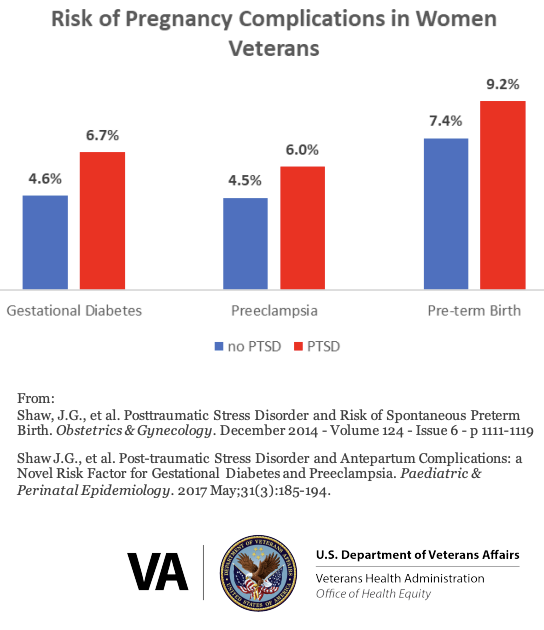
    VA research shows that women who experienced MST had an increased risk of spontaneous preterm birth, preeclampsia and gestational diabetes. 

    Dr. Kelsey Sprang Jones with Emory University School of Medicine told WABE that maternal trauma can also harm babies.

    In Georgia, mental health conditions are among the leading causes of pregnancy complications and maternal deaths. The risks are even higher for women veterans who have post-traumatic stress disorder.

    A chart showing the increase in pregnancy complication risk for women veteran who have experienced military sexual trauma