-
 play_arrow
Georgia NOW Live Streaming Now
-
 play_arrow
The Politics Bar After Hours - The Benchers


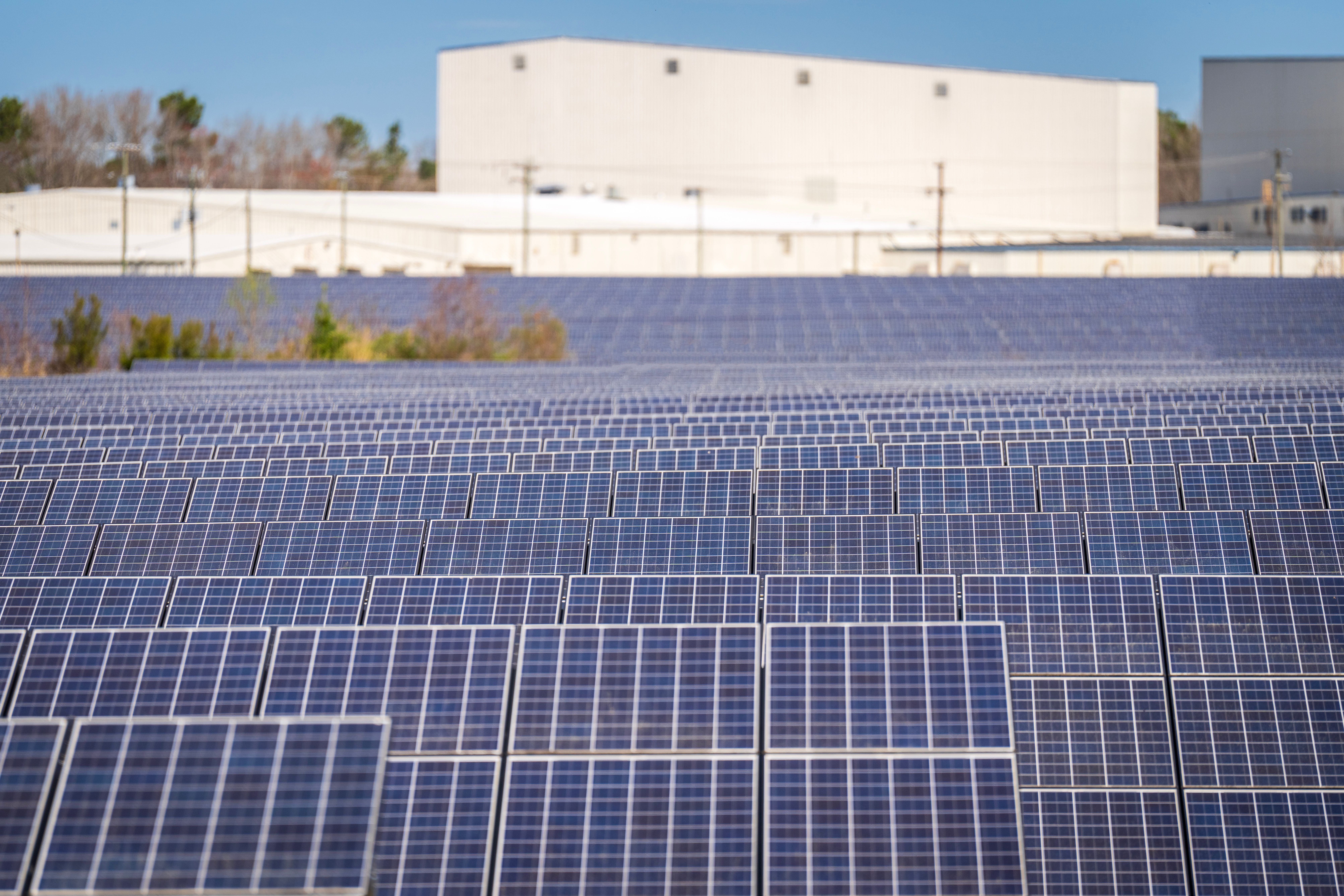
Georgia solar manufacturer pushes ahead as federal solar rules change
For Georgia’s growing solar manufacturing industry, building a factory is only part of the challenge. Companies also have to plan around a federal energy policy that can change dramatically from one administration to the next.
That reality is playing out at Qcells’ massive manufacturing complex in Cartersville.
The South Korean company has invested roughly $2.5 billion in the Georgia operation, making it one of the country’s largest efforts to produce solar components domestically. The facility is designed to strengthen the U.S. supply chain at a time when policymakers are pushing companies to rely less on overseas manufacturing.
But the incentives behind that push have shifted.
During the Biden administration, the Inflation Reduction Act encouraged domestic production through tax credits and additional incentives for projects using American-made components. Those policies helped make large U.S. manufacturing investments more attractive.
The Trump administration has since moved in a different direction, reducing or eliminating several clean energy incentives while imposing additional trade restrictions on imported solar materials. Those changes have made long-term planning more difficult across the industry.
Qcells says the scale of its Cartersville operation reflects the importance of producing more solar equipment in the United States.
Scott Bell, the company’s vice president of external affairs, pointed to the enormous infrastructure required to operate the plant, including its energy, water and chemical needs, as evidence of the investment involved in bringing solar manufacturing back to the country.
Industry leaders say the domestic supply chain is important, but building it comes with costs.
Ben Damiani, chief technology officer at Atlanta-based solar developer Cherry Street Energy, said repeated changes in government policy have become one of the industry’s biggest obstacles.
That uncertainty reaches beyond manufacturers. Developers also have to decide whether projects can still make financial sense when tax incentives, equipment costs and trade rules are changing.
Researchers and financial analysts say smaller companies could be especially vulnerable because they have fewer resources to absorb sudden changes in the market.
The impact is already being felt in project development. Energy advocates have reported billions of dollars in canceled renewable energy investments, while other developers have accelerated projects to take advantage of incentives before deadlines expire.
Tariffs present another problem. Even with more U.S. manufacturing, the country still depends on imported materials and components, meaning new trade restrictions can push costs higher.
Yet demand for solar has not disappeared.
Solar and battery storage accounted for the overwhelming majority of new U.S. electric generating capacity added early this year, reinforcing the technology’s growing role in the country’s energy mix. At the same time, long waits for other forms of power generation are making rapidly deployable resources more attractive to utilities and developers.
For Georgia, that leaves an industry with significant momentum but less certainty about what comes next.
Qcells’ Cartersville plant represents the push to build a domestic solar supply chain. The larger question is whether federal policy can provide enough stability for manufacturers and developers to keep investing at the same pace.
As the rules continue to change, Georgia’s solar industry will have to balance long-term investments against an increasingly unpredictable policy environment.
Similar posts
-

The Stephanie Miller Show
Weekdays at 10am
National morning drive radio and television star Stephanie Miller hosts The Stephanie Miller Show, reaching over six million listeners weekly on satellite and terrestrial radio, simulcast on FreeSpeech TV. A ratings powerhouse who dominated at KABC, KFI, and stations in New York and Chicago, she's been ranked on Talkers Magazine's "Heavy Hundred" for over a decade and won their Woman of the Year Award. Her sold-out Sexy Liberal Comedy Tour became the fastest-selling comedy tour in history, earning three Pollstar nominations and producing America's #1 comedy album. Praised by Rachel Maddow as "the high priestess of excellent liberal talk" and by Carol Burnett as "the Carol Burnett of radio," this Liberal icon—ironically the daughter of Barry Goldwater's 1964 VP running mate—is known as "The Voice of The Resistance."
close  From CBS News
- Fugitive wanted for allegedly bribing Venezuelan officials taken in U.S. custody October 11, 2026Alvaro Pulido was indicted in Miami federal court in 2019 and again in 2021 as part of an investigation into his longtime business partner, Alex Saab, a one-time ally of ousted President Nicolás Maduro.
- Full transcript of "Face the Nation with Margaret Brennan," Oct. 11, 2026 October 11, 2026On this "Face the Nation with Margaret Brennan" broadcast, Homeland Security Secretary Markwayne Mullin and Senate Majority Whip John Barrasso join Margaret Brennan.
- DHS secretary defends livestream of Fort Hood shooter's execution October 11, 2026Department of Homeland Security Secretary Markwayne Mullin defended the Pentagon's plan to livestream the execution of an ex-Army major who was convicted of the 2009 killing of 13 people at Fort Hood.
- Thousands still without power in Florida and Alabama as Isaias moves north October 11, 2026The storm, which hit as a Category 2 hurricane near Destin, Florida, has been linked to at least four deaths.
- Democrat Chris Pappas says "we're taking nothing for granted" in N.H. race October 11, 2026Democratic Rep. Chris Pappas, who's running to represent New Hampshire in the Senate, said that "we're taking nothing for granted" as Election Day approaches, amid a "tough race" in the Granite State.
- This week on "Sunday Morning" (Oct. 11) October 11, 2026A look at the features for this week's broadcast of the Emmy-winning program, hosted by Jane Pauley.
- 10/11: Face The Nation October 11, 2026This week on "Face the Nation with Margaret Brennan," U.S. Secretary of Homeland Security Markwayne Mullin joins, along with Sens. John Barrasso, Chris Murphy and Democratic Senate candidate Rep. Chris Pappas. Plus, Palantir's Chief Technology Officer Shyam Sankar.
- The girls of summer October 11, 2026Women's pro baseball has been largely inactive in this country since the pioneering All-American Girls Professional Baseball League folded 72 years ago. Now, with the new Women's Pro Baseball League (which debuted this summer), women are again taking to the diamond in a league of their own. Correspondent Faith Salie talks with #1 draft pick […]
- Extended interview: Steve Bannon October 11, 2026In this extended conversation, political strategist and podcaster Steve Bannon talks with "Sunday Morning" senior contributor Ted Koppel about populist and nationalist politics in the U.S. and abroad; the ground game of Democratic Socialists and prospects for the 2026 midterms; Trumpism and election denialism; and media coverage of politics.
- The dog rescuer October 11, 2026Christine Quaiff has captured dozens of lost dogs for grateful owners around Richmond, Virginia. Her most recent case was a desperate search for two Goldendoodles, Bailee and Tobey, who escaped from Annie Olup's car after she was in a near-fatal accident. Steve Hartman reports on how one tenacious searcher helped enable a tearful reunion.
- Fugitive wanted for allegedly bribing Venezuelan officials taken in U.S. custody October 11, 2026
Post comments (0)