-
 play_arrow
Georgia NOW Live Streaming Now
-
 play_arrow
Guardians Of Democracy



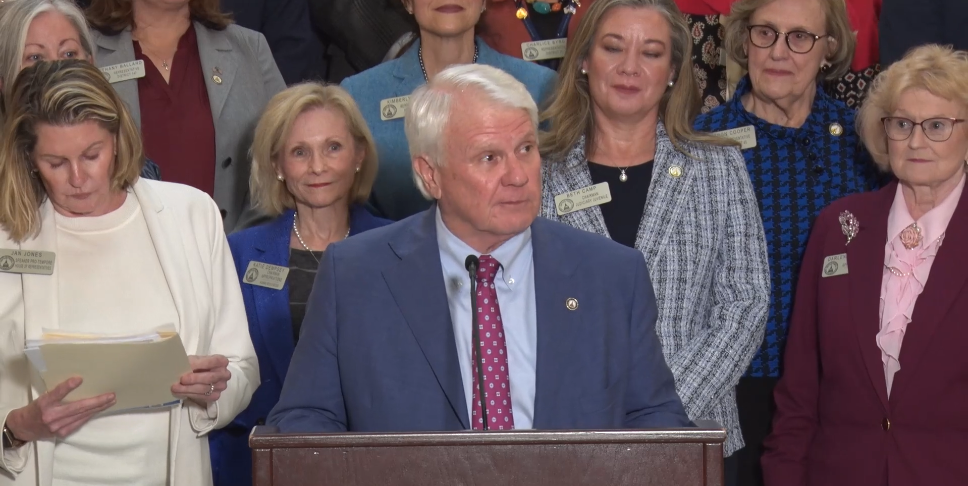
Georgia House Speaker Jon Burns announces a batch of bills at the Capitol Feb. 4 to support Georgia families. Credit: Georgia General Assembly livestream.
Proposed Georgia domestic violence registry draws debate
Georgia Republicans announced a slew of bills last week to support Georgia families, including legislation to create a registry of domestic violence offenders.
House Bill 1142 would create a time-limited, statewide domestic violence offender registry within the Georgia Bureau of Investigation.
“Here in Georgia, we believe in second chances, but we will not ignore patterns of recurring violence, and we will prioritize the safety of women, children, and families every step of the way,” said Georgia House Speaker Jon Burns.
In 2024, Georgia had 42,000 reported incidents of family violence and 159 confirmed deaths related to domestic violence.
Burns also said the House’s amended 2026 budget includes a $4.5 million investment in domestic violence shelters and sexual assault centers in Georgia.
“Placement on this registry sends a clear message that Georgia will not tolerate repeat domestic violence and that survivor safety comes first,” said state Rep. Leesa Hagan, R-Lyons.
However, activists and survivors of domestic violence are not convinced this measure will help and believe it could cause more harm than good.
Karimah Dillard, the director of policy for the Georgia Coalition Against Domestic Violence, said the fact that lawmakers are showing interest in the issue of domestic violence in Georgia gives her hope, but it’s a very complicated issue.
“Some survivors say, ‘Yes, we really want it,’ and some survivors say, ‘No, we really don’t because there are lots of unintended consequences that could come from that,’” she said. “We are trying to honor both the survivors and advocates who want to do this and the survivors and advocates who don’t want to do this.”
Advocates who do not support the bill expressed concerns about providing a false sense of security for people when they view the list, Dillard said.
“Georgia has about a 31 to 33% arrest rate when it comes to family and dating violence, so most abusers are not going to be on this list,” she said.
People might also lose their jobs if their name is on the list, and survivors of domestic violence might depend on that income for their children. Survivors might also be less likely to report domestic violence out of fear of retaliation from the perpetrator, Dillard said.
What does the bill actually do?
Dillard said the bill models legislation from Tennessee that went into effect in January.
For people who have two convictions of domestic violence offenses, including family and dating violence convictions, their name would go on the registry for two years. Those with three convictions would have their name on the registry for five years, and those with four or more convictions would have their name on the registry for 10 years.
The registry will include the name, date of birth, conviction date, county or counties of convictions and a current photograph of each person on the registry.
The goal of the bill is to reduce recidivism rates in Georgia, Dillard said, but the sex offender registry has not reduced recidivism.
“The DV registry is not the same as the sex offender registry, so I don’t want to compare apples to apples,” she said. “We’re just kind of taking in all of this information and trying our best to understand what the best path forward is.”


-

The Politics Bar
Weekdays at 6pm
Jody Hamilton and Shawn "Smith" Peirce are the proprietors of The Politics Bar, a progressive audio show that recreates the spirit of the old neighborhood bar where friends could discuss the news of the day without starting a brawl. Jody is an Emmy-nominated, award-winning media producer, actress, and radio host—daughter of TV producer Joe Hamilton and comedy legend Carol Burnett—who's made her own mark in media through "The Carol Burnett: Show Stoppers," "The Porkchop Playhouse," "From The Bunker" podcast, and her work as executive producer and fill-in host of "The Stephanie Miller Show". Shawn is a long-time national media producer and radio talent who's one of the few producers in U.S. political media to have worked on the left, right, and center, including more than a decade with "The Randi Rhodes Show" and stints producing "The Stephanie Miller Show," "The Bill Press Show," "The Laura Ingraham Radio Show," and "The Steele & Ungar Show" for SiriusXM. The show airs weeknights on progressive radio affiliates nationwide and is available on-demand through podcast platforms and Substack subscription.
close  From CBS News
- Today's CPI report is the best inflation news in months. Here's why. February 13, 2026The inflation reading, the lowest since May 2025, shows grocery, gas and rent prices are cooling.
- DOJ drops case against 2 men accused of assaulting ICE, citing new evidence February 13, 2026A judge dismissed charges against two men charged with assaulting ICE officers after the Justice Department said "newly discovered evidence" was "materially inconsistent" with the allegations.
- What services would be affected by a DHS government shutdown? February 13, 2026Funding for the Department of Homeland Security will expire at the end of the day Friday. Here's what will be affected.
- 8/10/2025: The Cap Arcona; Jamie Lee Curtis February 13, 2026First, a report on the sinking of the Cap Arcona Nazi ship. And, Jamie Lee Curtis: The 60 Minutes Interview.
- 11/16/2025: The President's Pardon; Anthropic; Chess Boxing February 13, 2026First, Trump pardon of billionaire sparks concerns. Then, what goes into testing Anthropic's AI. And, inside a chess boxing bout, where brain meets brawn.
- Au pair sentenced for scheme to kill lover's wife and another man February 13, 2026A Brazilian au pair got the maximum 10-year sentence after confessing to scheming with her lover to kill his wife and another man.
- Moore says Biden "needed to do more" on immigration, blasts Trump's crackdown February 13, 2026Maryland Gov. Wes Moore told CBS News that no administration has ever fully figured out an effective immigration system and only Congress can fix it.
- CEO of Dubai's largest port replaced after ties to Epstein revealed February 13, 2026Sultan Ahmed bin Sulayem, CEO and chairman of Dubai's DP World, appears in the Epstein files more than 4,700 times, according to the Justice Dept.
- Lindsey Vonn says she will need at least 2 more surgeries after crash February 13, 2026Lindsey Vonn broke her left leg in a crash during her downhill race at the Winter Olympics last weekend.
- 18-year-old sentenced to life for fatally shooting 5 in North Carolina February 13, 2026The judge rejected arguments that Austin David Thompson deserved the chance for release decades from now.
- Today's CPI report is the best inflation news in months. Here's why. February 13, 2026
Post comments (0)