-
 play_arrow
Georgia NOW Live Streaming Now
-
 play_arrow
War Is Stupid



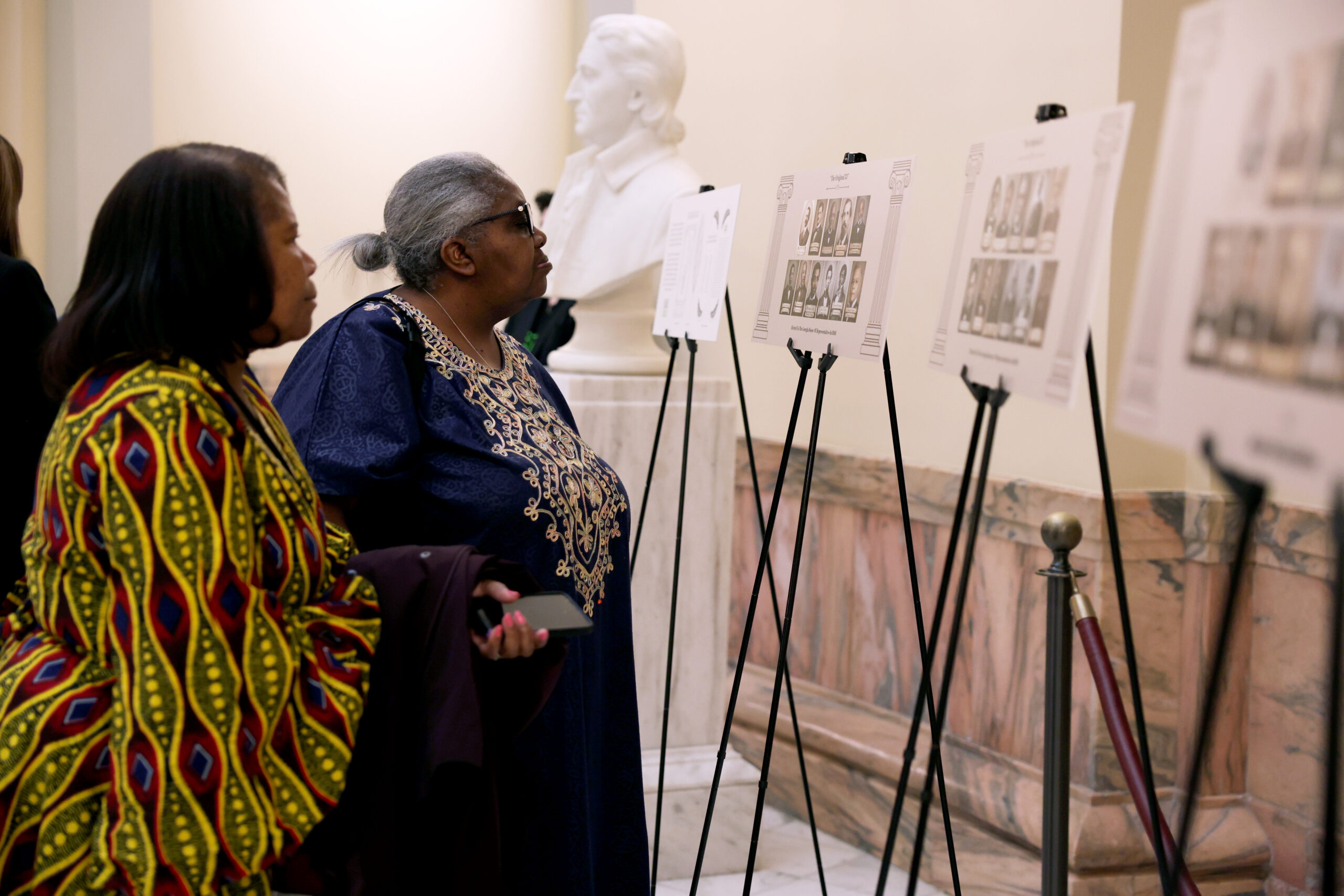
Jacquelin Ransom and Julia Britt, left to right, look at photos of the Original 33, the first African American members of the Georgia state legislature.
Crossover Day halts two Georgia voting bills, advocates weigh wins and losses
Two election bills failed to pass their chambers before Crossover Day. One voting rights activists celebrated. The other was a disappointment.
“Crossover sort of tells a little bit of the story of like, there was some progress made in two different directions. There’s a very clear pro voter agenda happening here, where we defeated (Senate Bill) 568, which was a bad bill for voters, and we have promoted this other bill, the Henry McNeal Turner Voting Rights Act, to stop any more kind of dangerous things from happening to voters,” said Isabel Otero, Georgia Policy Director for the Southern Poverty Law Center.
Senate Bill 568 was a massive bill that would have drastically changed the way voters cast their ballots in Georgia. It was narrowly defeated in the Senate on Crossover Day. However, activists expect some aspects of the bill to reemerge as amendments to bills that did survive March 6.
“It would have affected early voting sites for voters. It would have done a lot of things that, in our mind, are unnecessary and not well thought out,” Otero said.
Senate Bill 536, or the Henry McNeal Turner Voting Rights Act, also failed to pass its chamber, never receiving the opportunity for a vote.
What would the Voting Rights Act do?
The bill was named after Bishop Henry McNeal Turner, who was a former member of the state legislature, activist and leader in the African Methodist Episcopal church. He was among the 14 Black state representatives that were expelled by white lawmakers in 1868 shortly after being elected.
“His name attached to this bill sort of shows we believe in full citizenship. We believe in protecting the rights that allow us to safeguard that because these things are not guarding themselves,” Otero said. “We need to be proactive about protecting our rights, especially the voting rights because without voting rights, you can’t protect anything else.”
The Voting Rights Act would create a commission that would be in charge of determining whether any changes for elections would be discriminatory and increase the transparency on changes to election laws.
“Instead of waiting for a voter to be harmed, for their voice not to be heard,… we are saying before any of that, let’s actually make sure that this is a necessary change and that it will not impact any community inequitably,” she said.
Why do we need it?
Otero said the federal Voting Rights Act has slowly been chipped away at by the courts, and the reason voter discrimination has decreased has been because of the checks put in place to limit it.
“We need to at the state level start protecting ourselves, start making sure that we are putting forth a vision for what we want to see,” she said.
“We’re trying to reframe the conversation, which is yes, some of these federal protections exist, but they continue to go through changes because of the courts, and so rather than sort of waiting for a new set of legislation that will help, we need to do it at our state level,” she said.
What’s next?
Before the 2026 legislative session ends, Otero said they hope to receive a hearing for the bill, and they plan to meet with communities across the state to try to build momentum for the bill to pass next session.
“We’re trying to get a hearing on it, even if it’s post-crossover. We still want people to be heard. There’s a lot of community support and encouragement behind that bill,” she said. “We are going to put forth a vision for what we want and make it happen, and so this is our vision for what it would look like to truly protect voting rights in our state.”

-

The Ron Show
Weekdays at 4pm
Ron Roberts is a Georgia-born radio veteran and host of The Ron Show, Atlanta's only progressive audio platform airing weekdays on AmericaOne Radio. With an extensive background as an FM radio program director and broadcaster skilled in audio editing, voice acting, and commercials, Ron brings nearly three decades of radio experience to his show. The show covers Atlanta, metro Atlanta, Georgia, and national politics from a unique perspective—he's a self-described "run-of-the-mill Georgia-born gay progressive cat-dad realtor & talk show host". Ron frequently welcomes guests ranging from local activists to prominent national figures, including Marianne Williamson, Rep. Nikema Williams, actor Michael Kelly, and Sen. Shea Roberts.
close  From CBS News
- This week on "Sunday Morning" (March 15) March 13, 2026A look at the features for this week's broadcast of the Emmy-winning program, hosted by Jane Pauley.
- What we know about U.S. service members killed in Iran war March 13, 2026Since the start of the Iran war, 13 American service members have been killed.
- Suspect in synagogue attack lost family in recent airstrike in Lebanon, source says March 13, 2026The attacker rammed a vehicle into Temple Israel in West Bloomfield and was confronted and killed by security, Oakland County Sheriff Michael Bouchard said.
- These 2 bills would erase income taxes for millions of Americans March 13, 2026Two Democratic lawmakers are proposing tax reforms that would eliminate federal income taxes for millions of Americans.
- Hegseth says "no clear evidence" Iran is placing new mines in Strait of Hormuz March 13, 2026Defense Secretary Pete Hegseth and Joint Chiefs Chairman Dan Caine briefed on Operation Epic Fury in Iran Friday.
- U.S. military plane crashes in Iraq, officials say March 13, 2026An aerial refueling tanker crashed in Western Iraq, U.S. officials said.
- Economic growth late last year was much weaker than previously thought March 13, 2026GDP grew at a sluggish 0.7% pace in the final months of 2025 as the government shutdown hurt economic activity.
- One of FBI's most wanted fugitives is captured in quickest arrest ever March 13, 2026Samuel Ramirez Jr., 33, was wanted for his alleged involvement in the murders of two women on May 21, 2023.
- Business owner says rapidly rising price of diesel "is a shock to our whole system" March 13, 2026As gas prices increase, AAA says the cost of diesel is rising even faster. Diesel powers trucks, planes, trains and farm equipment. One business owner said if the spike continues, they may have to pass on some of the cost to the consumer. Skyler Henry reports.
- A teacher was found dead in her bed. Unusual clues left police searching for answers. March 13, 2026Jocelyn Peters, an award-winning third grade teacher in Missouri, was found shot to death in her bed in 2016. Inside her apartment, police found potato fragments splattered in her bedroom and when questioned about the case, a man swallowed potential evidence - leaving investigators searching for answers.
- This week on "Sunday Morning" (March 15) March 13, 2026
Post comments (0)