Category: Featured

  • Kemp signs Georgia public safety bills backing law enforcement, autism training

    Kemp signs Georgia public safety bills backing law enforcement, autism training

    Kemp signs Georgia public safety bills backing law enforcement, autism training

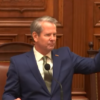
    Gov. Brian Kemp signed multiple bills Wednesday that impact public safety and law enforcement professionals across the state.

    “The Kemp family will always back the blue, and I’m proud to sign legislation today that ensures they are supported throughout their careers of service and into retirement,” Kemp said in a news release.

    Senate Bill 433, also known as Rio’s Law, creates a specialty license plate for individuals with autism or developmental disabilities. It also requires law enforcement training for interacting with these individuals.

    “From enhancing retirement benefits for state law enforcement officers to increasing penalties for those who victimize children and women in our state, and much more, these measures are just the latest reminder that criminals will not succeed in Georgia,” he said.

    Kemp also signed House Bill 1128 and Senate Bill 452. House Bill 1128 reopens the application window for officers who have sustained brain injuries to reapply for indemnification. Senate Bill 452 increases the state contribution to the 401(k)s of POST certified state law enforcement officers.

    “Time and time again, the brave men and women of Georgia’s state law enforcement have proven that they are the best in the nation,” state House Speaker Jon Burns said in the release. “The House is proud to stand alongside them as we work to strengthen public safety, support their families, and ensure they have the resources and benefits they have rightfully earned.”

    Kemp also signed seven other bills to do with law enforcement and public safety.

    • Senate Bill 285 reallocates 1.5% of local insurance premium tax to the Peace Officers Annuity Board to address revenue shortfalls.
    • Senate Bill 547 increases the penalties for offenses related to pimping and pandering. 
    • Senate Bill 160 establishes a regulatory framework for the use of Intelligent Speed Assistance devices for limited driving permits after a reckless driving conviction.
    • House Bill 1202 helps correct a minor error at the Georgia Motor Vehicle Crime Prevention Advisory Board.
    • House Bill 944 is an annual update of the Georgia code.
    • Senate Bill 383 clarifies the roles of review commission members and medical examiners and updates language and deadlines.
    • House Bill 549 extends the timeframe for reimbursements of training expenses by a subsequent employer of a peace officer.
  • Kemp signs Georgia education bills focused on literacy and school policy

    Kemp signs Georgia education bills focused on literacy and school policy

    Kemp signs Georgia education bills focused on literacy and school policy

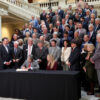
    Gov. Brian Kemp signed multiple bills into law Tuesday dealing with the state’s education system.

    House Bill 1193, or the Georgia Early Literacy Act of 2026, was a legislative priority for Speaker Jon Burns. 

    “Today’s signing of the Early Literacy Act of 2026 marks a historic step forward for Georgia’s children and our state’s future success,” Burns said in a news release. “This landmark legislation equips our students, teachers, and parents with the resources they need to strengthen literacy outcomes and ensure every child in Georgia has the opportunity to learn to read.”

    The bill enacts a grant program to hire a literacy coach in every elementary school, expands kindergarten offerings, creates a literacy task force, and allows the Governor’s Office of Student Achievement to produce a state literacy plan.

    “If young learners fail to learn how to read at the start of their educational careers, they’ll struggle to read to learn during the rest of their academic journeys,” he said. “This bill is a monumental step in our years-long work to ensure students have the literacy skills they need.”

    Kemp also signed House Bill 1009, which extends the statewide ban of cell phones and other personal electronic devices in public schools to include high school students.

    “Here in the No. 1 state for business and opportunity, our classrooms must be safe learning environments that serve as launching pads for success in the workforce,” Kemp said in a release. “The bills I signed today implement proven strategies to improve literacy and math scores, reduce distractions in the classroom, expand pathways to graduation, and further support hardworking educators and families. These are just the latest steps we’ve taken to create opportunity for all Georgians, no matter their zip code.”

    Here are the seven other bills Kemp signed into law:

    • House Bill 907 updates some requirements and policies to improve transparency for completion schools.
    • House Bill 1123 requires schools that offer after-school programs to extend those programs to pre-K students.
    • House Bill 1030 requires 60 minutes of core math instruction each day in grades four and five as well as other measures to increase math standards.
    • House Bill 1107 requires the Georgia Professional Standards Commission to develop standards to evaluate the performance of each program.
    • House Bill 1284 requires local school boards to issues a high school diploma for those students enrolled that have received a terminal medical diagnosis and are receiving end-of-life care.
    • Senate Bill 148 allows local school boards to provide instruction in hunting safety, establishes a pilot program on outdoor learning spaces and increases the number of sick days Georgia teachers can convert to personal leave from 3 to 5 days.
    • Senate Bill 150 extends the Return-to-Work program to 2030.
  • Federal court sides with South Georgia teacher in racial bias lawsuit

    Federal court sides with South Georgia teacher in racial bias lawsuit

    Federal court sides with South Georgia teacher in racial bias lawsuit

    Amid the Trump administration’s push to eliminate diversity, equity and inclusion programs, a South Georgia teacher recently received a legal win after a discrimination lawsuit.

    Lana Foster, a 65-year-old retiree, was fired in 2018 after 34 years of working for the Echols County School District, and she filed a lawsuit claiming years of racial discrimination, according to WABE. 

    Text messages from two school board members showed they used racial slurs and even compared Black children to animals, and two years after the court filing the district settled to pay Foster more than $130,000 and agree to change their hiring and recruitment policy.

    However, Foster said they have not complied with the settlement agreement.

    “It’s been almost seven years, and they still have not hired a minority or a Black [teacher] there at Echols County,” Foster said. “They’re, they’re just not doing it.”

    Recently, a federal appeals court sided with Foster finding that the seven school officials refused to comply with the settlement agreement. This means Foster can proceed with her case.

    “I wasn’t worried,” Foster said, “because when this started this years ago, I asked God, I said, ‘What would you have me to do?’ And he said, ‘fight.’”

    Echols County is a rural area along the Florida-Georgia line, and minority students make up more than half of the school district. Court documents show that during Foster’s tenure the district settled three complaints involving racially discriminatory practices. 

    “Our kids, no matter what their race is, they need to see some of their own in the school system,” Foster said. “And we do have a lot of professionals of all races that can help our kids. And they deserve that.”

  • Silence the Shame marks 10 years amid funding struggles

    Silence the Shame marks 10 years amid funding struggles

    Silence the Shame marks 10 years amid funding struggles

    An Atlanta nonprofit that provides mental health awareness and support marked 10 years of impact Tuesday.

    Silence the Shame, founded by Atlanta native Shanti Das, has reached more than 144,000 people nationwide, but like other nonprofits, budget constraints have started making it difficult to keep programs funded.

    Das said she founded the organization after her father and best friend died by suicide.

    “I was doing a radio interview literally with one of our local personalities, Ryan Cameron, and I said, I don’t know why people are ashamed to talk about mental health. You know, we just need to silence the shame, and it was literally born in an interview,” Das said.

    Jewell Gooding, executive director of the nonprofit, said she has faced her own struggles with mental health.

    “It gives me a sense of purpose, a mission to continue to forge forward,” Gooding said. “I myself am a person with lived experience. I struggle with depression and anxiety, and I’m also a parent of a child who has a mental illness, and we work together to create a space so that we don’t have to feel the shame.”

    Das said the nonprofit lost nearly half its funding last month due to grant cuts.

    “It was like a gut wrench, and it was very humbling, and I had to literally get on the phone along with my team and just started asking for support, trying to find emergency funding,” she said.

    People can support the organization by donating online or attending a fundraising event. The Creatives of Color closing party is happening this Saturday at the Fox Marquee Club, and a portion of the proceeds will go to Silence the Shame.

    “This lack of funding is not going to stop us with our megaphones. We’re going to continue to get out there and fight,” Das said. 

  • Death at Stewart Detention Center sparks calls for investigation

    Death at Stewart Detention Center sparks calls for investigation

    Death at Stewart Detention Center sparks calls for investigation

    A 33-year old man from Cuba died in the Stewart Detention Center in Lumpkin, Georgia on April 28.

    U.S. Immigration and Customs Enforcement issued a statement saying that Denny Adan Gonzalez died from a suspected suicide, but they are investigating the case, according to WABE.

    Gonzalez was arrested in North Carolina on assault and domestic violence charges and was transferred to the Stewart Detention Center in January.

    Officials told WTVM News Leader 9 that staff of CoreCivic, the private prison company that runs the detention center, found Gonzalez unresponsive in his cell.

    Immigrant rights advocates say Stewart Detention Center is one of the deadliest ICE facilities in the country, and they are calling for a full, independent investigation into the death of Gonzalez.

    Samantha Hamilton, a senior litigation staff attorney with Asian Americans Advancing Justice, said she heard about the death from a client.

    “Every employee at ICE and CoreCivic who runs the profit-maximizing venture that is the Stewart Detention Center have blood on their hands,” Hamilton said. “The detention and deportation machine continues to remind us that it is not intended to keep communities safe, and it never was.”

  • Poll finds rising economic anxiety among rural Georgia voters

    Poll finds rising economic anxiety among rural Georgia voters

    Poll finds rising economic anxiety among rural Georgia voters

    Voters in rural Georgia might be feeling some anxiety around economic issues and a willingness to rethink the role of government.

    A new poll found that a somewhat surprising number of rural voters in Senate battleground states were feeling deep economic anxiety.

    The Center for Rural Strategies commissioned the survey, and Dee Davis, president of the organization, said the results caught researchers off guard.

    “They were full of doubt, uncertainty; not happy with the way things were going,” Davis said. “That was a little surprising. We’re not used to seeing this much pessimism in rural America.”

    The rising cost of living, especially food prices, was the most important issue for 55% of rural voters. While 46% of respondents said the rural economy had gotten worse over the past year, those who said they wanted the government to “get out of their way” dropped from 42% in 2023 to 32%.

    Davis said the shift is possibly due to prolonged economic pressure. Only a slim majority of respondents said the economy was not working well for them personally, and Trump’s favorability was at 52% favorable and 46% unfavorable.

    “Right now, people are admitting that they need government support,” Davis observed. “There’s weakness in the private sector and the high costs of living are really influencing rural voters.”

    The online survey was conducted with 600 rural voters from March 18-25 by Lake Research Partners with a margin of error of plus or minus four percentage points.

  • Georgia advocates react as court restores temporary access to abortion pill

    Georgia advocates react as court restores temporary access to abortion pill

    Georgia advocates react as court restores temporary access to abortion pill

    Georgia advocates for reproductive rights responded to the U.S. Supreme Court’s decision Monday that temporarily restores access to abortion medication by mail.

    The court halted an appellate court order to block the U.S. Food and Drug Administration rule that allowed the abortion pill mifepristone to be prescribed online and dispensed through the mail.

    However, the administrative stay is only temporary and will remain in place until 5 p.m. on May 11. Now, the court needs to consider whether it will approve the drug companies’ requests to block the order while litigation proceeds.

    Meanwhile, Georgia advocates for abortion rights remain active in calling on the courts to dismiss any case that limits reproductive freedoms.

    Monica Simpson is the executive director of Sister Song: Women of Color Reproductive Justice Collective. She told WABE that restricting mifepristone would lead to unnecessary and potentially harmful delays in care.

    “Mifepristone is one of two medications commonly used in medication abortion. It is also used in miscarriage care, helping people safely manage pregnancy loss without unnecessary delays. Restricting access to this medication is not just about mifepristone. It is about power and control over who gets to make decisions about their own body,” Simpson said.

    The FDA approved mifepristone as a safe and effective way to terminate pregnancy in 2000 and loosened restrictions on the drug in 2021 so that patients could receive the medication by mail.

    Dr. Neil Winawer with Emory University School of Medicine told Fox 5 Atlanta that this change was mostly due to the coronavirus pandemic.

    “During the pandemic in 2021, it was dangerous to be around patients and so this really grew out of that, and because of that, in 2021, the FDA said it was okay to be able to provide abortion care services via telemedicine and prescribe mifepristone,” he said.

    The Supreme Court is expected to make another decision on the case in the coming weeks.

    “Once again, our rights are in limbo, and once again the constant rollercoaster of court orders will cause confusion among everyday people just trying to get care. But make no mistake: abortion is still legal in Georgia. Feminist Center will continue to offer care, including prescribing mifepristone. And we will fill in any gaps that this judicial back-and-forth has manufactured,” said Kwajelyn Jackson, the executive director of the Feminist Center for Reproductive Liberation, in a news release.

  • Kemp sets special election as Democrats battle for Scott’s open seat

    Kemp sets special election as Democrats battle for Scott’s open seat

    Kemp sets special election as Democrats battle for Scott’s open seat

    Gov. Brian Kemp has set the date for a special election to fill the seat of former U.S. Rep. David Scott. Meanwhile, six Democrats debate for the open seat for the primary election.

    Scott passed away on April 22 at the age of 80 after a life of public service. Now, there will be a special election to fill the seat for the remainder of Scott’s term. The special election will be held July 28, and the victor will serve in Scott’s seat until the winner of the general election in November is sworn into office.

    However, the primary election for the 13th Congressional District is already underway with six Democrats now vying for the open seat. 

    Scott’s name will remain on the primary ballot because there was no time to reprint the ballots, according to the Georgia Secretary of State’s office. Any votes cast for Scott will not count.

    The six candidates faced off in an Atlanta Press Club debate last Monday trying to distinguish themselves on issues, such as health care, public safety and affordability.

    Everton Blair Jr., a former Gwinnett County School Board chairman, said during the debate that he wants to focus on housing affordability for young adults.

    “When I talk to people in the community, especially young people in the community, we’re strapped,” Blair Jr said. “It is a problem that the median first-time homebuyer’s age in this country is 41 years old. I’m the only candidate on this stage that’s under that age.”

    Although expanding health care was a unifying topic, Dr. Heavenly Kimes said she wanted to focus on healthcare access.

    “As a health care provider, the things that I would do to actually prevent the gaps are, of course, make sure that we have Medicaid for all. But we also have telemedicine,” Kimes said. “I think that we should actually make sure that we have hospitals close enough that we can, we don’t have to drive hours.”

    Rev. Jeff Fauntleroy Sr. emphasized mental health services specifically.

    “We can’t look at mental health as something that’s bad. We can wait until something happens to address the problem,” Fauntleroy Sr. said. “ We have stigmatized it too much, and we have to make sure that it’s part of preventive care, because it is.”

    Dr. Joe Lester said he wanted to focus on public safety, specifically involving shootings and gun violence.

    “Gun violence is out of hand. All we do in Atlanta and all over the country is shoot, shoot, shoot,” he said. “I think the federal government has a role in making sure that we fund policies and folks. But for the most part, a lot of gun violence is tied directly to poverty. And you can’t really, really, really just police your way out of poverty. We need more jobs.”

    State Sen. Emanuel Jones said he would support research by creating a study committee to address the issue.

    “The federal government does play a role because the federal government can provide resources so that we can do just as Texas has done, which has a smaller percentage of gun violence in our state by creating a study committee that’s within one of our universities,” Jones said.

    State Rep. Jasmine Clark also shared her views on education.

    “I personally believe that the government doesn’t necessarily need to make money off of student loan debt. We could do 0% interest. Congress actually does have that authority. We have money for a lot of things. And I think investments in education are one of the things that help people have upward mobility and economic opportunities,” Clark said.

    Jonathan Chavez is the only Republican running for the district primary and, therefore, did not have a debate.

  • Kemp says Voting Rights ruling won’t affect 2026 maps, signals 2028 changes

    Kemp says Voting Rights ruling won’t affect 2026 maps, signals 2028 changes

    Kemp says Voting Rights ruling won’t affect 2026 maps, signals 2028 changes

    Gov. Brian Kemp said Friday that the recent U.S. Supreme Court’s ruling on the Voting Rights Act will not impact the upcoming midterm elections, but Georgians can expect a change in district maps ahead of the 2028 elections.

    In the case, the court ruled that Section 2 of the law required evidence of intentional discrimination, which would require a stricter burden of proof for voting rights cases.

    Following the ruling, some Georgia Republicans called on Kemp to convene a special session to allow the state legislature to change the maps before November’s midterm elections.

    State Sen. Greg Dolezal, R-Cumming and candidate for lieutenant governor, said in a Facebook video that Georgia needs to remove what he called “racial gerrymandered maps.”

    “The last thing Republicans need to do is be weak-kneed in this moment. This is a time to be bold. This is a time to be aggressive. In Georgia, that means calling a special session and redrawing our maps,” Dolezal said.

    Kemp praised the Supreme Court’s ruling Friday saying that it “restores fairness to our redistricting process and allows states to pass electoral maps that reflect the will of the voters, not the will of federal judges.”

    Although Kemp said changes to the maps would not occur within the next few weeks or months considering early voting is already underway for the primaries, he did not give a timeline for when the legislature will begin work on redrawing the district maps.

    “If indeed the legislature were to take this ruling and decided to redraw a district which is currently a Democratic district, it would probably, by removing say some of the Black population from that district, result in that district becoming more Republican,” Charles Bullock, a UGA professor of political science, told CBS News. 

  • New dashboard tracks mental health insurance gaps in Georgia

    New dashboard tracks mental health insurance gaps in Georgia

    New dashboard tracks mental health insurance gaps in Georgia

    Georgians for a Healthy Future has launched a new centralized dashboard to help Georgians track issues with insurance coverage for mental health care claims. 

    Under Georgia’s Mental Health Parity Act passed in 2022 and federal parity regulations, Georgia health insurers are required to cover mental health and substance-use conditions at the same rate as physical health conditions. 

    The dashboard can help Georgians monitor how well their insurers comply with parity rules.

    Whitney Griggs with Georgians for a Healthy Future told Georgia Public Broadcasting that several insurers receive “F” grades because they do not provide real-world data on consumer experiences.

    “What they don’t show you is the experience of the consumer trying to get that mental health care,” Griggs said. “How hard is it for them to actually find a provider in their area? And that is measurable, and something that, until we have that information, we’ll never really know how consumers are fairing with the mental health parity law.” 

    Most private insurers in Georgia do not follow standard templates for reporting making it harder to understand how coverage is applied.

    In January, the state fined health insurance companies for nearly $25 million for violating Georgia’s Mental Health Parity laws.

    “I said it before and I’ll say it again: insurance companies will not take advantage of consumers under my watch,” John King, Georgia’s Insurance and Safety Fire Commissioner, said in a statement. “These companies are not above the law, and I am taking definitive action to hold them accountable for denying Georgians the care they need.”

    Georgians can file parity complaints through Georgia’s Department of Community Health website.