-
 play_arrow
Georgia NOW Live Streaming Now
-
 play_arrow
The Politics Bar After Hours - The Benchers



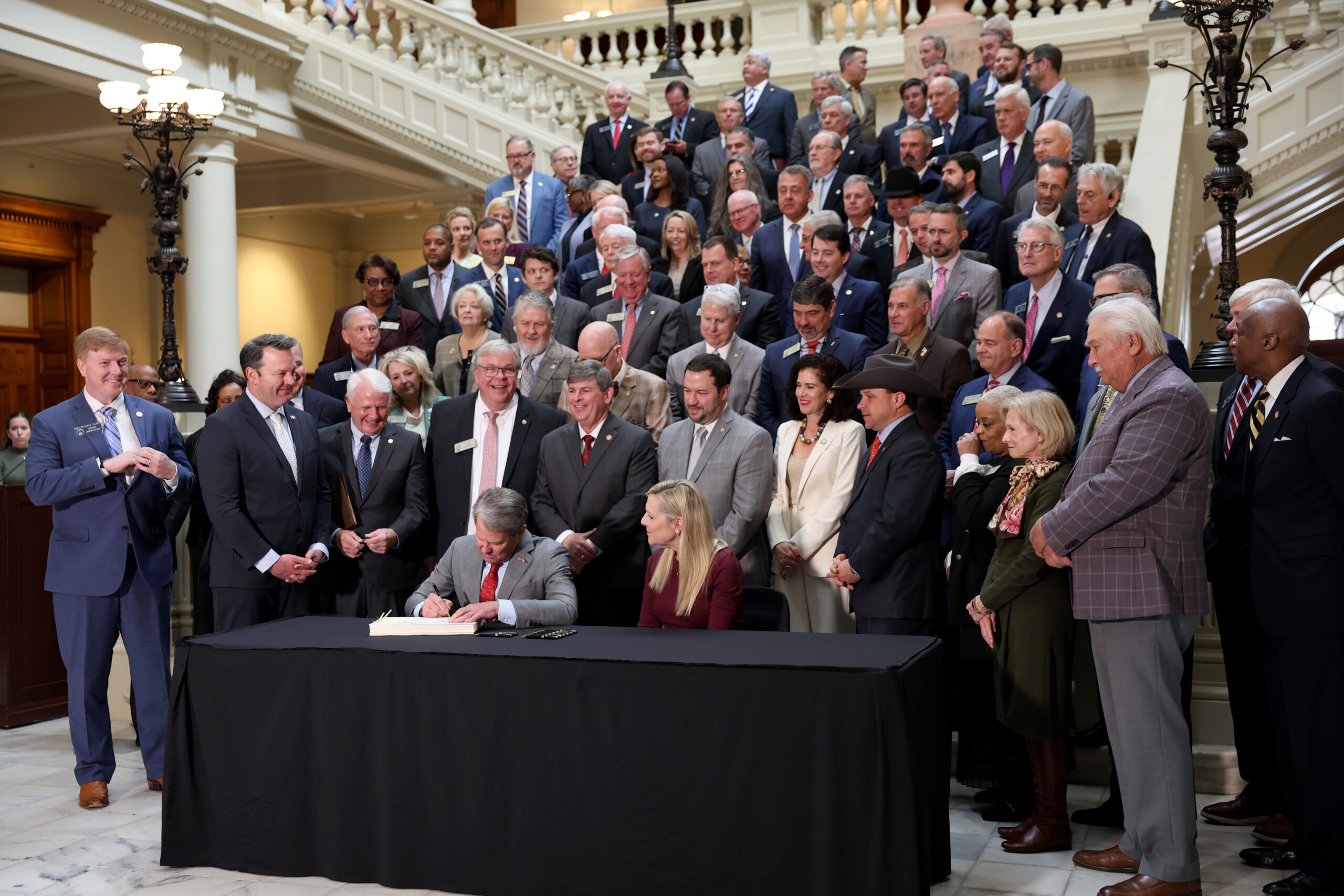
Gov. Brian Kemp signs the amended budget for the 2026 fiscal year at the state Capitol.
Gov. Kemp signs tax cuts, business growth bills into Georgia law
Gov. Brian Kemp signed another round of bills Monday focused on lowering taxes and supporting economic growth.
“We’ve remained the No. 1 state for business for a historic 12 consecutive years because of our commitment to growing opportunity and budgeting conservatively,” Kemp said in a news release. “That approach has allowed us to return billions of dollars to taxpayers, and the legislation I signed today will keep that momentum going as we further lower our state income tax rate, deliver on meaningful property tax relief, and ensure job creators have the opportunity to grow and thrive in the Peach State.”
House Bill 463 lowers the state income tax rate from 5.99% to 4.99% beginning Jan. 1, 2026, and increases the standard deduction. It also raises the retirement income exclusion to $70,000 in 2027 and repeals some tax credits and sales and use tax exemptions.
Senate Bill 33 was a priority for state House Speaker Jon Burns. The bill enacts broad property tax reform by establishing a new Local Homestead Option Sales Tax to provide homeowner tax relief.
“When Georgians across the state made clear that affordability was the number one issue they faced, Republican leadership delivered real, meaningful relief that allows hardworking taxpayers to keep more of their money where it belongs – in their pockets,” Burns said in a news. “From another historic income tax rebate and rate reduction to property tax relief and lower costs at the pump, the Georgia House was proud to champion measures delivering results when and where they were needed most.”
Here are the other 7 pieces of legislation Kemp signed Monday.
- House Bill 1129 creates guardrails for state-designated enterprise zones.
- House Bill 1185 modernizes complex corporate litigation policies and revises some standards around the Georgia Statewide Business Court.
- House Bill 328 increases the tax credit for student scholarship organizations, expands student eligibility and increases accountability measures for program providers.
- House Bill 445 expands the right of business owners in Georgia to appeal tax reassessments of certain high-value tangible personal property to a hearing officer and establishes new qualifications and procedures for officers handling appeals.
- House Bill 987 codifies a voluntary framework for independent contractors to receive portable benefits through dedicated accounts, allowing contributions without affecting their employment classification.
- House Bill 1209 establishes a limited sales and use tax exemption for construction materials used in specific developments near certain state-owned convention facilities.
- Senate Bill 111 expands the eligibility criteria for rural hospital organizations to include freestanding emergency departments and lowers indigent care thresholds.

-

The Stephanie Miller Show
Weekdays at 10am
National morning drive radio and television star Stephanie Miller hosts The Stephanie Miller Show, reaching over six million listeners weekly on satellite and terrestrial radio, simulcast on FreeSpeech TV. A ratings powerhouse who dominated at KABC, KFI, and stations in New York and Chicago, she's been ranked on Talkers Magazine's "Heavy Hundred" for over a decade and won their Woman of the Year Award. Her sold-out Sexy Liberal Comedy Tour became the fastest-selling comedy tour in history, earning three Pollstar nominations and producing America's #1 comedy album. Praised by Rachel Maddow as "the high priestess of excellent liberal talk" and by Carol Burnett as "the Carol Burnett of radio," this Liberal icon—ironically the daughter of Barry Goldwater's 1964 VP running mate—is known as "The Voice of The Resistance."
close  From CBS News
- At least 4 dead as Isaias brings threat of floods across the Southeast October 10, 2026More than 600,000 customers are without power after Isaias made landfall as a hurricane on the northern Gulf Coast.
- Vehicle driven by ICE agents in Texas hits and injures man, sheriff says October 10, 2026The Harris County Sheriff's Office said in a statement that the incident appears to have occurred during an ICE enforcement action.
- House candidate who reported rape on campaign trail details why she came forward October 10, 2026In the days since U.S. House candidate Bernadette Greene-Placentia publicly came forward alleging she was raped over the summer while repairing a campaign sign, she says women have been reaching out to her to share their own stories.
- This week on "Sunday Morning" (Oct. 11) October 10, 2026A look at the features for this week's broadcast of the Emmy-winning program, hosted by Jane Pauley.
- Christa Pike released from hospital following botched execution, lawyers say October 10, 2026Christa Pike survived despite being given two doses of a lethal injection.
- Pope says death penalty "inadmissible" amid U.S. plans to livestream execution October 10, 2026The firing squad execution of Nidal Malik Hasan, convicted of a 2009 shooting at Fort Hood, will be livestreamed, the U.S. Defense Department said.
- What we know about the man shot by ICE in New York City October 10, 2026There's outrage in New York City after a Bronx man was shot by an Immigration and Customs Enforcement agent while his young child sat in the backseat of his car. The Department of Homeland Security says the man "decided to not comply with lawful orders." Camilo Montoya-Galvez reports.
- Isaias makes landfall as Category 2 hurricane October 10, 2026Isaias made landfall on the northern Gulf Coast as a Category 2 hurricane, but within hours weakened to a post-tropical cyclone.
- Blanche, other DOJ appointees can take part in campaigns, memo says October 10, 2026The Justice Department has loosened the guidelines for the attorney general and other senior political appointees, allowing them to participate in political activities.
- 10/10: CBS Saturday Morning October 10, 2026Isaias makes landfall, President Trump's Russian diesel deal, plus the search for Amelia Earhart. All this and more.
- At least 4 dead as Isaias brings threat of floods across the Southeast October 10, 2026
Post comments (0)