-
 play_arrow
Georgia NOW Live Streaming Now
-
 play_arrow
They Were Warned



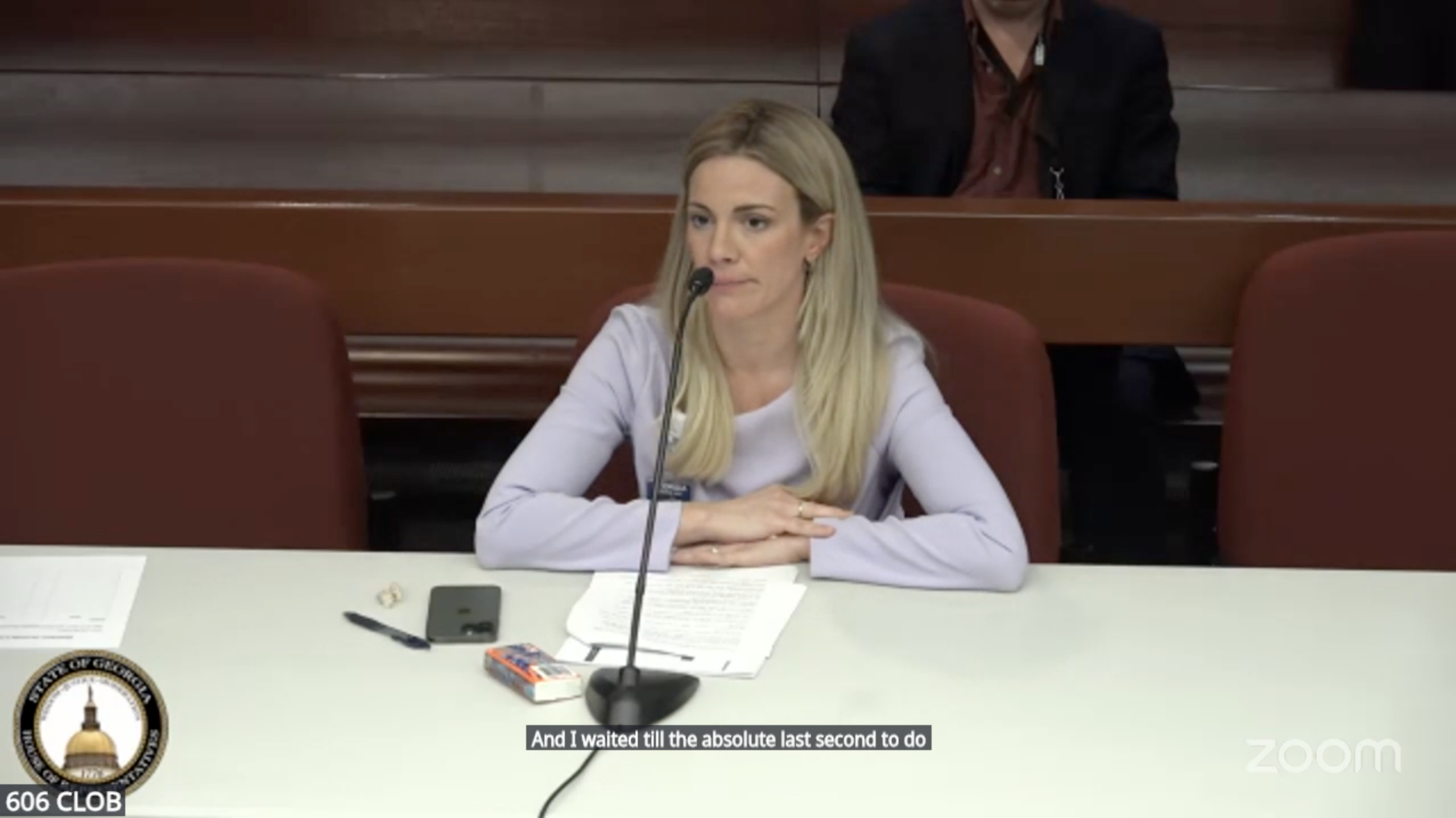
Georgia Department of Human Services Commissioner Candice Broce testifies before lawmakers regarding the department's deficit. Credit: Georgia House Press Office livestream.
Georgia Senate considers SNAP oversight bill critics say could hurt families
In the early morning hours of March 7, a bill passed its chamber of the Georgia General Assembly helping it survive a critical deadline.
House Bill 947, which aims to reduce error rates in the Supplemental Nutrition Assistance Program (SNAP), passed in a last minute vote 95-66.
Isabel Otero, Georgia Policy Director for the Southern Poverty Law Center (SPLC), said they are advocating for the bill to be amended in the Senate.
“On the House side, very, very late into the evening, past midnight, they did call HB 947, which is a bill that creates new requirements for SNAP recipients, for data matching and other things that, again, are redundant policies meant to potentially root out fraud in a way that is actually just going to cause more bureaucratic nonsense and potentially kick off of SNAP a lot of eligible families,” she said.
When Congress passed the One Big Beautiful Bill Act, or HR 1, earlier last year, it shifted a lot of the administrative costs of SNAP to state governments. HB 947 was proposed in Georgia to reduce error rates because states now have to pay more depending on their error rate.
“The problem is that error rates do not equal fraud,” she said. “It is often times just administrative errors. It is somebody types something in wrong, something hasn’t been updated quickly enough.”
Daniel Kanso, the vice president of public policy at the Georgia Budget and Policy Institute, said that HB 947 replicates processes that the federal government already does, such as asset tests.
“Basically, when you add on these layers, you make it likelier that they’re going to be errors, and so if the state’s error rate is above 13%, the state will be in the highest cost sharing cohort, which in Georgia could mean about half a billion dollars a year that the state would have to pay in cost sharing,” he said.
Reducing the error rate could reduce the state’s cost sharing to just under $200 million, he said.
HB 947 goes above and beyond what the federal law requires to verify information requiring more work for administrators and more bureaucracy for people in need to navigate, Otero said.
“In an attempt to lower error rates, because they are equating it so clearly with fraud, they’re saying, ‘We need to then just put all these new checks and balances into the system in order to prevent it.’ And unfortunately, it’s just going to backfire,” Otero said.
The Division of Family & Children Services (DFCS) in the Georgia Department of Human Services (DHS) administers SNAP benefits, and DFCS has faced a more than $85 million deficit this year, which was luckily backfilled by lawmakers. DHS as a whole has an annual budget of $1.2 billion.
“You can imagine adding half a billion dollars onto that potentially could cause real financial problems for the state that could even jeopardize the SNAP program altogether,” Kanso.
In the 2027 proposed budget, the state has allocated $46 million to cover administrative costs that the federal government is no longer going to cover and $11 million to hire about 320 case managers through DFCS, Kanso said.
Part of SPLC’s proposal regarding HB 947 is to appoint a study committee on the issue to figure out what would be a viable solution to reduce error rates before instituting legislation, Otero said.
Applying for SNAP benefits is already filled with checks and administrative processes that are difficult to navigate.
“If you’ve never done this before, it’s actually not that easy for you to figure it out, and adding more things that will slow this process down for people is only going to make it worse,” Otero said. “We’re going to leave Georgians hungry.”

-

The Thom Hartmann Program
Weekdays at 1pm
Thom Hartmann is a New York Times bestselling, four-times Project Censored Award-winning author and host of The Thom Hartmann Program, which broadcasts live nationwide each weekday from noon to 3pm Eastern. For 20 years, the show has reached audiences across AM/FM stations throughout the US, on SiriusXM satellite radio, and as video on Free Speech TV, YouTube, Facebook, and X/Twitter.
close  From CBS News
- Severe weather, TSA staffing shortage wreak havoc on travel March 17, 2026Roughly 9,000 flights were canceled and 25,000 delayed since Sunday as a winter storm slammed parts of the U.S. It comes amid a TSA staffing shortage, as employees work without pay through the partial government shutdown. Kris Van Cleave reports.
- Eye Opener: Extreme weather impacts millions and causes travel chaos March 17, 2026Extreme weather is impacting millions of Americans from coast to coast, creating long lines at airports and a travel mess. Plus, Israel says it has killed two more Iranian leaders. All that and all that matters in today's Eye Opener.
- Blizzards, severe storms, heat wave hit U.S. with array of extreme weather March 17, 2026From a surprising heatwave in California to blizzards burying parts of the Midwest and storms rolling over the East Coast, chaotic weather put more than half the nation's population in the path of extreme conditions.
- 3/9: Face the Nation March 17, 2026This week on "Face the Nation with Margaret Brennan," after a whiplash week of on-again, off-again tariff announcements, Canadian ambassador to the U.S. Kirsten Hillman joins to discuss the costs and consequences of a trade war. Plus, former White House Russia expert Fiona Hill discusses President Trump's diplomatic pivot on Ukraine.
- Illinois Senate primary race is test of Pritzker's sway, Democrats' views of ICE, outside spending March 17, 2026The 2026 Democratic primary campaign for retiring Sen. Dick Durbin's Senate seat is largely a three-person race. Voters go to the polls Tuesday in Illinois.
- Alleged pipe bomber argues charges should be tossed under Jan. 6 pardons March 17, 2026A man who was accused of planting pipe bombs outside the RNC and DNC on the eve of the Jan. 6 attack is arguing he is covered by President Trump's sweeping pardons of alleged Jan. 6 rioters.
- Kouri Richins, mom who wrote grief book, found guilty of murdering her husband March 17, 2026Jurors delivered their verdict Monday in the trial of Kouri Richins, a Utah mother accused of murdering her husband and later publishing a children's book about grief.
- 3/16: The Takeout with Major Garrett March 17, 2026Trump calls for other countries to help open Strait of Hormuz; White House chief of staff Susie Wiles diagnosed with breast cancer.
- "All the Empty Rooms" wins Oscar for memorializing kids killed in school shootings March 17, 2026The film follows CBS News correspondent Steve Hartman and photographer Lou Bopp through their seven-year journey to document the toll of America's school shooting epidemic.
- Steve Hartman's Oscar for a short film meant to make us feel again March 17, 2026For years, CBS News' own Steve Hartman and photographer Lou Bopp documented the bedrooms of children killed in school shootings. The resulting film, "All the Empty Rooms," just won an Oscar. Tony Dokoupil has more.
- Severe weather, TSA staffing shortage wreak havoc on travel March 17, 2026
Post comments (0)