-
 play_arrow
Georgia NOW Live Streaming Now
-
 play_arrow
Slow Down And Think



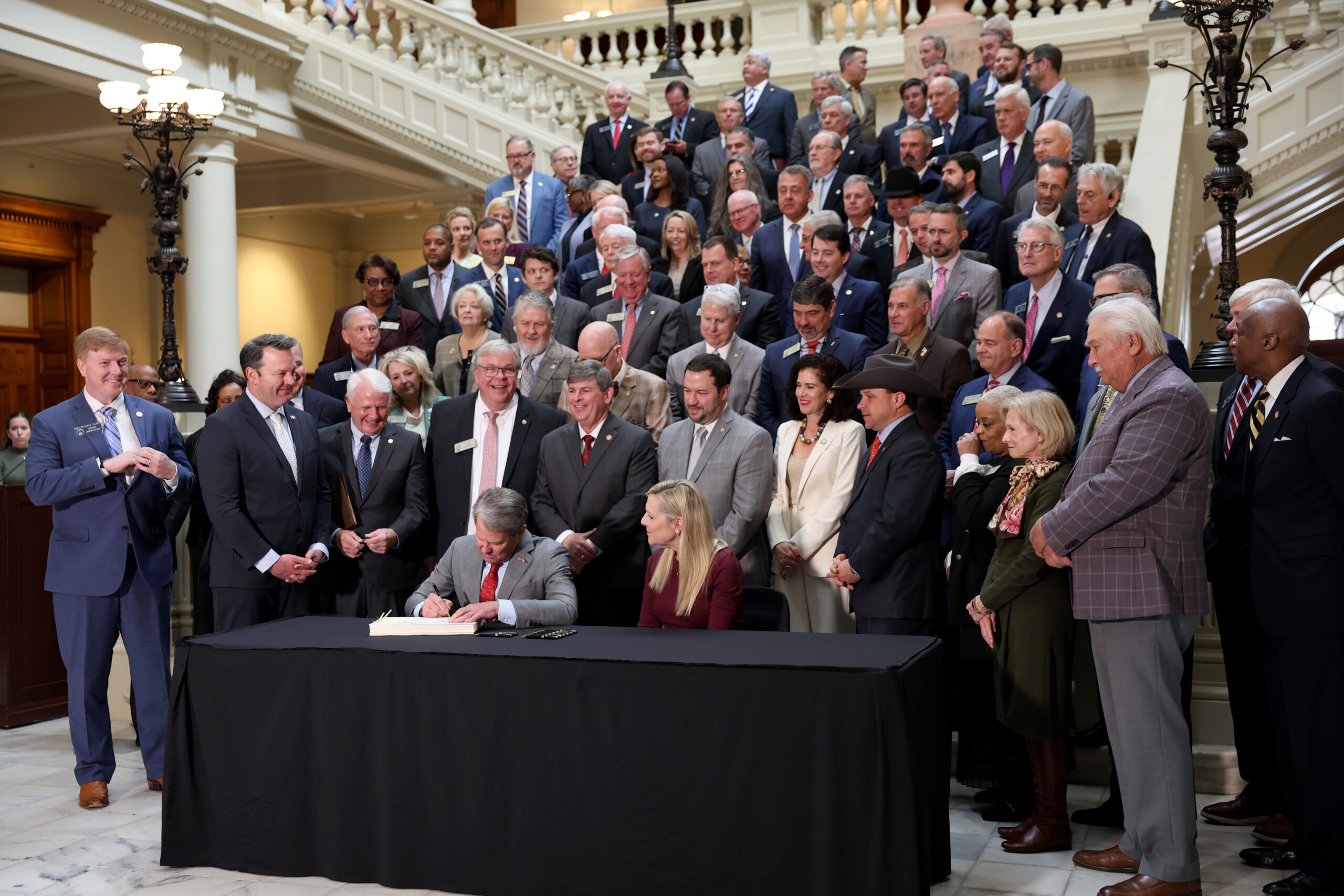
Gov. Brian Kemp signs the amended budget at the state Capitol Tuesday for the 2026 fiscal year.
Advocates criticize “Messaging Bills” as Georgia session winds down
There are two weeks left in the 2026 Legislative Session, and lawmakers are rushing to get their legislation to the governor’s desk.
A legislative session during an election year is always interesting with several lawmakers looking to make a statement to their constituents.
But, the process can be frustrating for advocacy groups trying to make meaningful change.
Isabel Otero, the Georgia Policy Director for the Southern Poverty Law Center, said they have seen several messaging bills this session.
“That’s a little bit frustrating because it does waste a little bit of the time of advocates, constituents, the legislature, just because they’re trying to kind of get some messages out there that sort of go beyond what their scope truly is while they’re in a legislative session,” she said.
Some of the bills Otero is referring to are Senate Bill 552 and Senate Bill 116.
Senate Bill 552, or the True Patriotism and Universal Student Access Act, would authorize the organization of partisan and nonpartisan student groups and gatherings in schools.
“There’s a lot of reasons why this is not written well, one of which is that there are protections for students both for their First Amendment rights in schools, but also there are protections beyond that,” Otero said. “If you’re creating a situation where you’re going to allow clubs and things to be there that could harm a student or could potentially feed into harassment or bullying of certain students because of their immutable characteristics, that’s a different problem that you’re going to create for schools.”
Otero said they have seen bipartisan resistance to this bill. Initially, the bill failed to pass the Senate 21-32, but then it passed 46-7. It’s currently in the state House.
Senate Bill 116 would require the collection of DNA samples from any individual in a detention facility charged with a misdemeanor or felony who is subject to an immigration detainer notice.
“What that does is create a situation where for the first thing that you did that caused an arrest… you’ve now sort of incriminated yourself for any other crime by providing the swab, and so what we’ve been trying to say is you are sort of running afoul of the Constitution,” she said.
Otero said the law would violate the Fourth Amendment, which protects people from unreasonable searches and seizures and ensures the right to privacy.
“Public safety is important, but the Constitution is not optional, so you cannot just go around making public policy that doesn’t make sense just because you’re trying to show your constituents that you’re working for them,” she said.
Other bills that Otero mentioned as messaging bills include House Bill 1076, which has been viewed as an anti-protesting bill, and Senate Bill 591, which prohibits the disruption of religious services.


-

The Stephanie Miller Show
Weekdays at 10am
National morning drive radio and television star Stephanie Miller hosts The Stephanie Miller Show, reaching over six million listeners weekly on satellite and terrestrial radio, simulcast on FreeSpeech TV. A ratings powerhouse who dominated at KABC, KFI, and stations in New York and Chicago, she's been ranked on Talkers Magazine's "Heavy Hundred" for over a decade and won their Woman of the Year Award. Her sold-out Sexy Liberal Comedy Tour became the fastest-selling comedy tour in history, earning three Pollstar nominations and producing America's #1 comedy album. Praised by Rachel Maddow as "the high priestess of excellent liberal talk" and by Carol Burnett as "the Carol Burnett of radio," this Liberal icon—ironically the daughter of Barry Goldwater's 1964 VP running mate—is known as "The Voice of The Resistance."
close  From CBS News
- Pete Hegseth says "largest strike package yet" coming today in Iran war March 19, 2026Defense Secretary Pete Hegseth said the U.S. has struck more than 7,000 targets across Iran since the war began.
- ICE detainee deaths on record pace, with Afghan refugee latest to die March 19, 2026Even after accounting for record-high detention populations, the rate of deaths per 10,000 ICE detainees was the highest in 2025 than in any year since the COVID-19 pandemic hit in 2020.
- Watch Live: Gabbard, intel officials testify at House hearing on threats to U.S. March 19, 2026Director of National Intelligence Tulsi Gabbard, CIA Director John Ratcliffe and other top officials are appearing before the House Intelligence Committee on Thursday.
- Rapper wins lawsuit against police over mocking their raid: "It's for Americans" March 19, 2026Afroman spoke to CBS News after he won the case, which tested the limits of parody and the license artists can take in social commentary directed at public figures.
- Over a third of TSA officers call out at 3 major U.S. airports in single day March 19, 2026"The morale is getting worse by the day because no one knows when this is gonna end," said Cameron Cochems, a lead TSA officer in Boise, Idaho.
- Surging U.S. gas prices could erase bigger tax refunds, analysis finds March 19, 2026Stanford economists estimate that the typical U.S. household will spend an additional $740 on gas this year because of the jump in global oil prices.
- Here's how much U.S. families need to make to feel economically secure March 19, 2026Many Americans feel like they live in a "hamster wheel economy," said one expert who studies economic security.
- Coast Guard investigating deaths of 2 crew members on barge off Alaska March 19, 2026Two tugboat crew members were killed and two others were injured in what the Coast Guard called a "confined space incident" aboard a barge in Alaska.
- Epstein's longtime lawyer to testify to House committee today March 19, 2026A lawyer who worked closely with Jeffrey Epstein for decades before becoming an executor of his estate will be questioned Thursday by the House Oversight Committee.
- House Democrats walk out of tense briefing with Bondi over Epstein files March 19, 2026A group of House Democrats walked out of a closed-door briefing with Attorney General Pam Bondi on the Jeffrey Epstein probe late Wednesday, as tensions over the DOJ's handling of the Epstein case continue to simmer.
- Pete Hegseth says "largest strike package yet" coming today in Iran war March 19, 2026
Post comments (0)