-
 play_arrow
Georgia NOW Live Streaming Now
-
 play_arrow
War By Whim



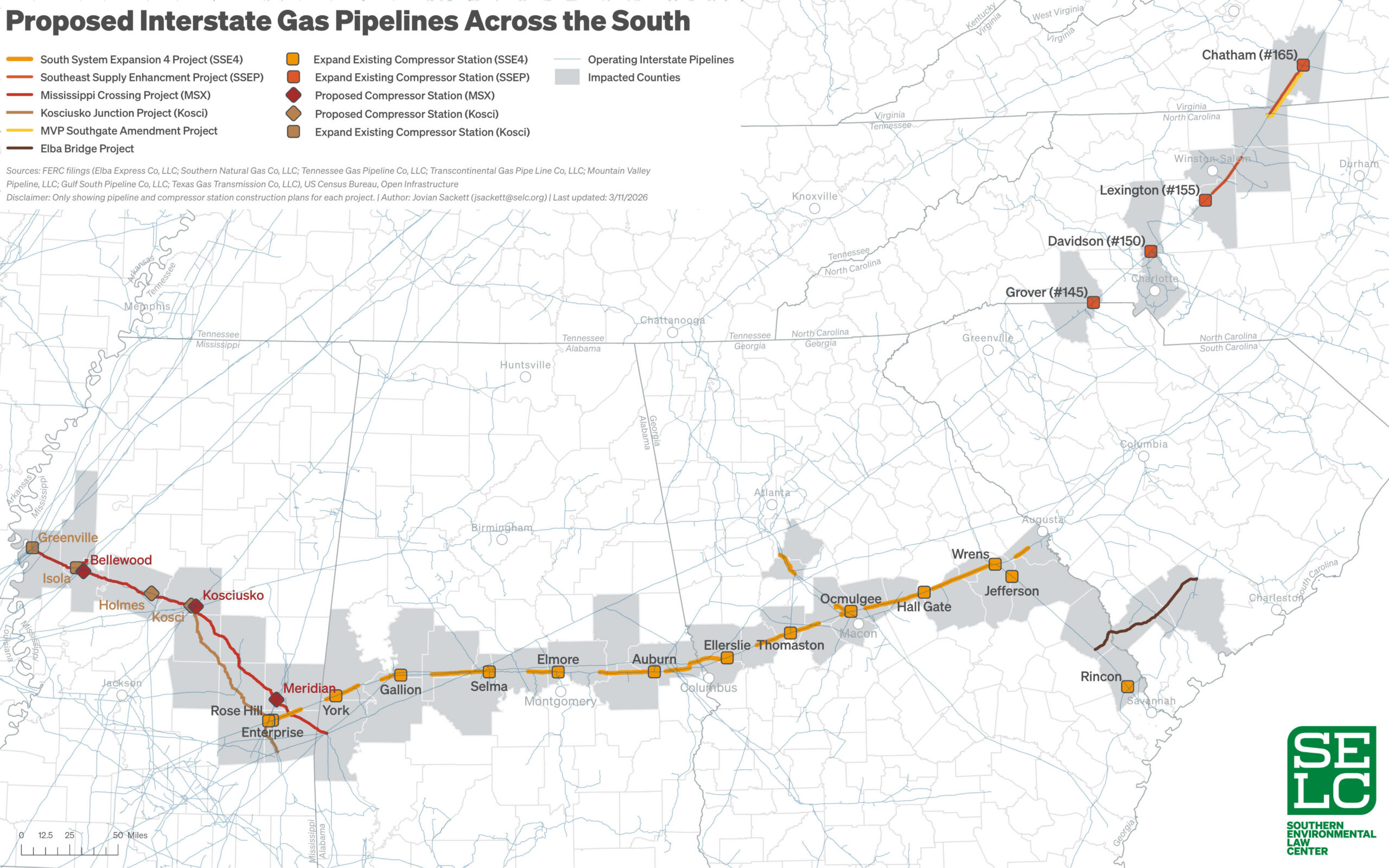
The Southern Environmental Law Center created a map of the proposed interstate gas pipeline.
$3.5B methane pipeline proposed to cut across Georgia sparks concerns
Middle Georgia community members expressed their concerns over the expansion of a pipeline that will cut through Georgia from Columbus to Augusta.
The Federal Energy Regulatory Commission (FERC) stopped in Macon, Sandersville and Griffin last week to talk with community members about the South System Expansion 4, or SSE4, which is a $3.5 billion project by Kinder Morgan, according to The Telegraph.
More than 50 people attended the event in Macon and expressed concerns about health impacts and pollution to water and air.
“As a physician, I already have enough problems with hydrocarbon related deaths from Plant Scherer, and we certainly don’t need a methane pipeline,” Macon-Bibb resident Nick Pietrzak told The Telegraph.
Farmers also expressed concerns about the impact of the pipeline on the soil and potential contamination to water sources.
“We’ve only got so much land that we can farm on. If we keep ruining it, where are we going to get our food?” Ellie Wangrin told The Telegraph
The Southern Environmental Law Center reported that the expansion, including the Mississippi Crossing expansion, would include around 500 miles of new pipe in the ground and impact 18 river watersheds. The group has a form people can submit to FERC Secretary Debbie-Anne A. Reese to express their concerns.
Rev. Jay Horton, the communications manager for Georgia Interfaith Power & Light, posted a video on Facebook in February asking people to sign a petition against the pipeline.
“This methane gas pipeline expansion would run from Augusta, Georgia to Enterprise, Mississippi, crossing 11 rivers and over a thousand bodies of water, places where endangered wildlife live, people fish, swim, farm, and get their drinking water. Gas pipelines not only threaten clean water, their compressor stations also increase air pollution, exposing communities to greater risk of asthma, cancer, and heart attacks,” he said.
If approved, the pipeline is expected to be operational by 2028. The FERC is accepting public comments on the issue until March 23.


-

ReRon
Daily Rerun of The Ron Show
Ron Roberts is a Georgia-born radio veteran and host of The Ron Show, Atlanta's only progressive audio platform airing weekdays on AmericaOne Radio. With an extensive background as an FM radio program director and broadcaster skilled in audio editing, voice acting, and commercials, Ron brings nearly three decades of radio experience to his show. The show covers Atlanta, metro Atlanta, Georgia, and national politics from a unique perspective—he's a self-described "run-of-the-mill Georgia-born gay progressive cat-dad realtor & talk show host". Ron frequently welcomes guests ranging from local activists to prominent national figures, including Marianne Williamson, Rep. Nikema Williams, actor Michael Kelly, and Sen. Shea Roberts.
close  From CBS News
- Nicholas Brendon, "Buffy the Vampire Slayer" actor, dies at 54 March 21, 2026Nicholas Brendon was best known for his role as Xander Harris on all seven seasons of "Buffy the Vampire Slayer."
- Hawaii flooding prompts evacuation orders for more than 5,000 people March 21, 2026Honolulu officials said the Wahiawa dam is failing or expected to fail soon and residents nearby should evacuate.
- Colombian President Petro caught up in narcotics trafficking probes, sources say March 21, 2026The separate narco-trafficking investigations, based out of New York's Southern and Eastern districts, didn't set out to target Petro, but his name has come up during the course of the probes, one source said.
- This week on "Sunday Morning" (March 22) March 21, 2026A look at the features for this week's broadcast of the Emmy-winning program, hosted by Jane Pauley.
- Chuck Norris, action icon and "Walker, Texas Ranger" star, dies at 86 March 20, 2026Chuck Norris' family said his death at 86 was sudden, but did not share any details on the cause.
- Remembering Chuck Norris' life and career March 20, 2026Action star and martial artist Chuck Norris has died, his family said. He was 86. Mark Strassmann looks back at his life and career.
- Judge strikes down restrictive Pentagon press policy, finding it violates First Amendment March 20, 2026A federal judge has struck down some of the Defense Department's strict controls on how journalists with access to the Pentagon are allowed to report — ending a policy that caused many news outlets to leave the Pentagon.
- Frustrated flier says "we should not be punished" over funding fight in Congress March 20, 2026The Senate again failed to move forward with legislation to fund the Department of Homeland Security, extending the shutdown that has snarled air travel around the country. Skyler Henry reports.
- 3/20: CBS Evening News March 20, 2026Emergency evacuations ordered in Hawaii; travelers spend up to three hours in TSA lines.
- DOJ seeks to drop case against ex-police officers charged in Breonna Taylor's death March 20, 2026Two former Louisville police officers were facing civil rights charges in connection with the 2020 shooting death of Breonna Taylor.
- Nicholas Brendon, "Buffy the Vampire Slayer" actor, dies at 54 March 21, 2026
Post comments (0)